

DCOCO
Collection
2 items • Updated
This repository contains the DCOCO (DFlash Contextual Corrector) speculative-decoding drafter
for Qwen/Qwen3-4B, from the paper Contextual Correction of
Parallel Drafts for Speculative Decoding. It is a draft model: serve it together with
Qwen/Qwen3-4B, which verifies every token, so the output distribution is exactly the target model's.
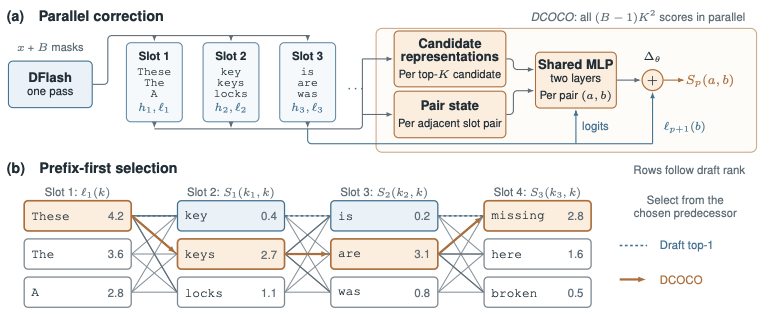
Diffusion-style drafters such as DFlash propose a whole block of tokens in a single pass, but each position is predicted without seeing which tokens were chosen before it. DCOCO keeps the top-16 candidates at every drafted position and scores how well each candidate fits each candidate at the next position, using candidate representations and a pair state over adjacent slots, all in one small batched pass. A prefix-first walk over those scores then picks the draft. This restores intra-block dependencies at a cost of a few percent of the drafting cycle.
| Target (verifier) model | Qwen/Qwen3-4B |
| Architecture | DCOCODraftModel: 5-layer DFlash drafter (hidden size 2560, bidirectional in-block attention) plus the DCOCO corrector |
| Corrector | K = 16 candidates per slot, candidate width 128, pair-state width 128, 2-layer scoring MLP (hidden 256); 1,443,073 parameters |
| Draft block | 15 drafted tokens per round (anchor position predicts); up to 16 tokens committed per verification |
| Target layers read | 1, 9, 17, 25, 33 |
| Training data | ~800K prompts from the stem, math and code splits of Nemotron Post-Training Dataset v2 and CodeAlpaca-20k, with continuations regenerated by Qwen/Qwen3-4B (greedy, thinking off, up to 4,096 tokens) |
| Training | 6 epochs of DFlash drafter training, then 6 epochs of joint training with the corrector; AdamW, lr 6e-4, cosine schedule |
| Format | BF16 safetensors (2.63 GB), vLLM-native config |
DCOCO runs in vLLM, through the speculative-decoding dflash method; vLLM selects the corrector
from the checkpoint's DCOCODraftModel architecture. This requires a vLLM build with DCOCO
support, such as the DCOCO image (vllm/vllm-openai:v0.31.0 with the DCOCO overlay).
vllm serve Qwen/Qwen3-4B \
  --speculative-config '{"method": "dflash", "model": "TD-Labs/Qwen3-4B-DCOCO", "num_speculative_tokens": 15}'
Check that the server log shows Resolved architecture: DCOCODraftModel. With any other
architecture, vLLM serves the drafter as plain DFlash without the corrector. Then query it like
any OpenAI-compatible server:
curl localhost:8000/v1/chat/completions -H 'content-type: application/json' -d '{
  "model": "Qwen/Qwen3-4B",
  "messages": [{"role": "user", "content": "How many positive whole-number divisors does 196 have?"}],
  "chat_template_kwargs": {"enable_thinking": false}
}'
num_speculative_tokens can be lowered (down to 1) but not raised above 15.
All results below are from the paper (Tables 14, 15, 16, 17 and 20). Setup: one NVIDIA B200 GPU, vLLM 0.27, concurrency 1 unless noted, thinking off with at most 2,048 generated tokens (4,096 with thinking on), 128 prompts per benchmark (all 30 of AIME-25, all 80 of MT-Bench, 880 of SPEED-Bench). Throughput (tok/s) is the median per-request rate (output tokens / request latency, including prefill); speedup is relative to the target model alone. τ is the mean accepted length per verification round, including the bonus token. T=0 is a single greedy run; T=1 is the mean over seeds 42, 43 and 44.
Greedy decoding (T=0) in the first four columns, sampling (T=1) in the last four.
| Benchmark | No-spec tok/s | DCOCO tok/s | Speedup | τ | No-spec tok/s | DCOCO tok/s | Speedup | τ |
|---|---|---|---|---|---|---|---|---|
| MATH-500 | 366.2 | 2165.5 | 5.91× | 7.967 | 365.2 | 1644.7 | 4.50× | 6.041 |
| AIME-25 | 364.4 | 2085.9 | 5.72× | 7.368 | 364.0 | 1194.1 | 3.28× | 4.623 |
| GSM8K | 369.6 | 1638.4 | 4.43× | 6.082 | 368.6 | 1525.7 | 4.14× | 5.610 |
| HumanEval | 370.6 | 1475.8 | 3.98× | 5.351 | 370.1 | 1372.1 | 3.71× | 4.949 |
| MBPP | 370.2 | 1435.3 | 3.88× | 5.297 | 369.4 | 1260.7 | 3.41× | 4.603 |
| LiveCodeBench | 369.2 | 1754.1 | 4.75× | 7.127 | 369.2 | 1301.1 | 3.52× | 5.110 |
| MT-Bench | 369.0 | 661.3 | 1.79× | 2.946 | 369.0 | 639.1 | 1.73× | 2.669 |
| Arena-Hard-v2 | 369.6 | 692.3 | 1.87× | 2.716 | 369.9 | 631.4 | 1.71× | 2.393 |
| Alpaca | 368.1 | 658.7 | 1.79× | 2.515 | 367.2 | 631.3 | 1.72× | 2.357 |
| SPEED-Bench | 369.1 | 759.0 | 2.06× | 2.753 | 368.8 | 668.3 | 1.81× | 2.425 |
| Average | 368.6 | 1332.6 | 3.62× | 5.012 | 368.1 | 1086.8 | 2.95× | 4.078 |
Thinking off:
| Method | tok/s (T=0) | Speedup (T=0) | τ (T=0) | tok/s (T=1) | Speedup (T=1) | τ (T=1) |
|---|---|---|---|---|---|---|
| DFlash | 1096.9 | 2.98× | 4.162 | 927.6 | 2.52× | 3.476 |
| Domino | 1202.7 | 3.27× | 4.861 | 995.7 | 2.71× | 3.977 |
| DSpark | 980.1 | 2.66× | 3.889 | 838.4 | 2.28× | 3.281 |
| DCOCO | 1332.6 | 3.62× | 5.012 | 1086.8 | 2.95× | 4.078 |
Thinking on (extended reasoning):
| Method | tok/s (T=0) | Speedup (T=0) | τ (T=0) | tok/s (T=1) | Speedup (T=1) | τ (T=1) |
|---|---|---|---|---|---|---|
| DFlash | 753.5 | 2.08× | 2.778 | 673.5 | 1.87× | 2.460 |
| Domino | 785.2 | 2.17× | 3.089 | 696.7 | 1.93× | 2.702 |
| DSpark | 670.6 | 1.85× | 2.565 | 610.2 | 1.69× | 2.313 |
| DCOCO | 862.2 | 2.38× | 3.129 | 765.3 | 2.12× | 2.741 |
Aggregate output tokens/s, averaged over the ten benchmarks.
| Concurrent requests | DFlash | Domino | DSpark | DCOCO | DCOCO vs. best other |
|---|---|---|---|---|---|
| 1 (T=0) | 1096.9 | 1202.7 | 980.1 | 1332.6 | +10.8% |
| 4 (T=0) | 4097.1 | 4032.1 | 3517.5 | 4660.3 | +13.7% |
| 8 (T=0) | 6942.6 | 6560.9 | 5953.9 | 7781.7 | +12.1% |
| 16 (T=0) | 10940.3 | 9633.9 | 9448.6 | 12215.5 | +11.7% |
| 32 (T=0) | 14181.1 | 11966.5 | 12746.7 | 15602.7 | +10.0% |
| 1 (T=1) | 927.6 | 995.7 | 838.4 | 1086.8 | +9.1% |
| 4 (T=1) | 3345.6 | 3226.4 | 2929.6 | 3721.2 | +11.2% |
| 8 (T=1) | 5697.0 | 5306.7 | 5015.9 | 6191.9 | +8.7% |
| 16 (T=1) | 9092.8 | 7830.4 | 7965.6 | 9834.0 | +8.2% |
| 32 (T=1) | 11676.9 | 9628.3 | 10525.8 | 12476.2 | +6.8% |
Qwen/Qwen3-4B and must be served with exactly that target model.@article{eisenstadt2026dcoco,
title = {Contextual Correction of Parallel Drafts for Speculative Decoding},
author = {Eisenstadt, Roy and Lidar, Harel and Gonen, Tal and Luxembourg, Omer and
Zimerman, Itamar and Wolf, Lior and David, Eli and Naiman, Ilan},
year = {2026}
}