

Paper and card: nano-edge-tts v1 (earlier model) and v2 (this model) named explicitly
Browse files- README.md +2 -2
- paper/figures/listening.png +0 -0
- paper/figures/listening.svg +34 -34
- paper/figures/make.py +3 -3
- paper/figures/offsets.svg +57 -57
- paper/figures/params.png +0 -0
- paper/figures/params.svg +80 -80
- paper/paper.pdf +2 -2
- paper/paper.typ +7 -7
README.md
CHANGED
|
@@ -19,7 +19,7 @@ tags:
|
|
| 19 |
# nano-edge-tts-standalone
|
| 20 |
|
| 21 |
Text to speech in **3.27M parameters**, distilled from [Kokoro-82M](https://huggingface.co/hexgrad/Kokoro-82M) without running any
|
| 22 |
-
of its networks or installing any of its software. It builds on [nano-edge-tts](https://huggingface.co/drmhse/nano-edge-tts),
|
| 23 |
which replaced Kokoro's decoder and kept Kokoro's 28.5M-parameter text side; here the text side is replaced too.
|
| 24 |
|
| 25 |
From Kokoro it keeps only data: the phoneme vocabulary, the 28 English voice vectors, and the text front end. Everything
|
|
@@ -30,7 +30,7 @@ learned is new:
|
|
| 30 |
- a **mapper** (0.96M, 80 frames/s) and a **renderer** (0.79M, 160 frames/s) that set per-frequency gains on a pulse train and on
|
| 31 |
white noise. Two inverse STFTs make the audio, and no network runs at audio rate.
|
| 32 |
|
| 33 |
-

|
| 34 |
|
| 35 |
**Paper:** [Kokoro-Quality Speech in 3.3M Parameters: Where a Text-to-Speech Model's Capacity Was Not Needed](paper/paper.pdf).
|
| 36 |
**To rebuild it:** every checkpoint of the training chain with its arguments and logs ([`chain/`](chain)),
|
|
|
|
| 19 |
# nano-edge-tts-standalone
|
| 20 |
|
| 21 |
Text to speech in **3.27M parameters**, distilled from [Kokoro-82M](https://huggingface.co/hexgrad/Kokoro-82M) without running any
|
| 22 |
+
of its networks or installing any of its software. It builds on [nano-edge-tts v1](https://huggingface.co/drmhse/nano-edge-tts),
|
| 23 |
which replaced Kokoro's decoder and kept Kokoro's 28.5M-parameter text side; here the text side is replaced too.
|
| 24 |
|
| 25 |
From Kokoro it keeps only data: the phoneme vocabulary, the 28 English voice vectors, and the text front end. Everything
|
|
|
|
| 30 |
- a **mapper** (0.96M, 80 frames/s) and a **renderer** (0.79M, 160 frames/s) that set per-frequency gains on a pulse train and on
|
| 31 |
white noise. Two inverse STFTs make the audio, and no network runs at audio rate.
|
| 32 |
|
| 33 |
+

|
| 34 |
|
| 35 |
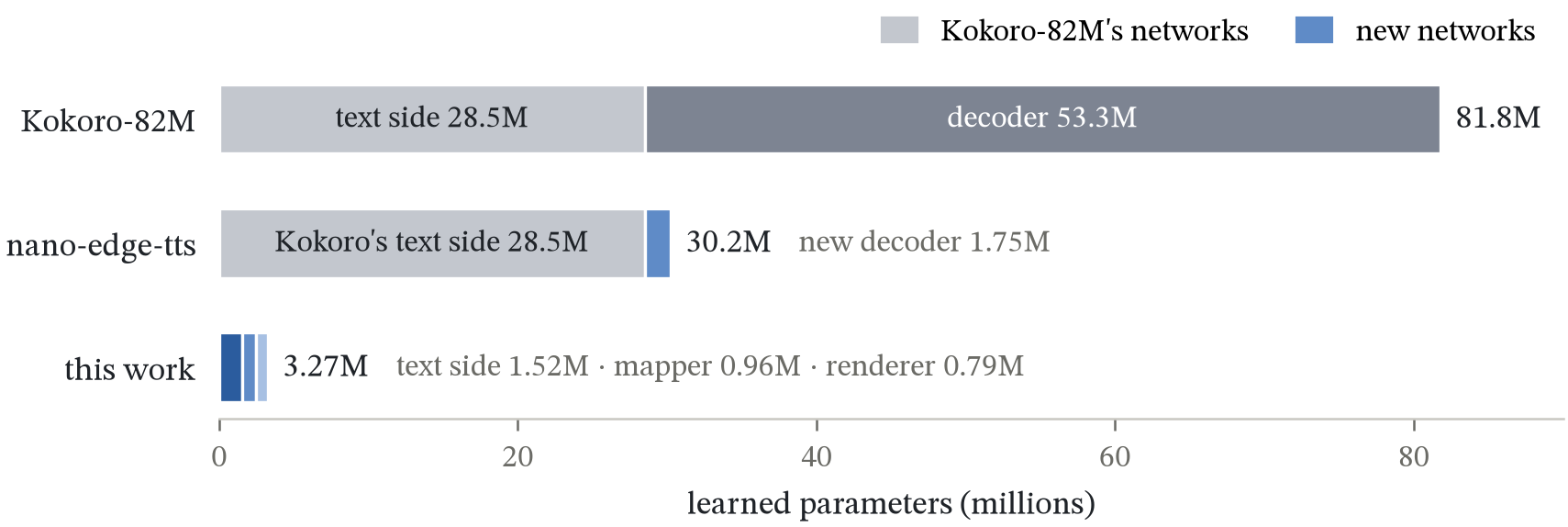
**Paper:** [Kokoro-Quality Speech in 3.3M Parameters: Where a Text-to-Speech Model's Capacity Was Not Needed](paper/paper.pdf).
|
| 36 |
**To rebuild it:** every checkpoint of the training chain with its arguments and logs ([`chain/`](chain)),
|
paper/figures/listening.png
CHANGED
|
|
paper/figures/listening.svg
CHANGED
|
|
paper/figures/make.py
CHANGED
|
@@ -37,8 +37,8 @@ def bar_label(ax, x, y, s, dark):
|
|
| 37 |
|
| 38 |
def params():
|
| 39 |
rows = [('Kokoro-82M', [('text side', 28.5, KOK_LIGHT), ('decoder', 53.3, KOK_DARK)], '81.8M'),
|
| 40 |
-
('nano-edge-tts', [('Kokoro\'s text side', 28.5, KOK_LIGHT), ('', 1.75, BLUE_MID)], '30.2M new decoder 1.75M'),
|
| 41 |
-
('
|
| 42 |
'3.27M text side 1.52M · mapper 0.96M · renderer 0.79M')]
|
| 43 |
fig, ax = plt.subplots(figsize=(W, 1.65))
|
| 44 |
for i, (_, parts, total) in enumerate(rows):
|
|
@@ -76,7 +76,7 @@ def listening():
|
|
| 76 |
('F4 + post-filter', count(os.path.join(RES, 'listening_F4sharp_vs_kokoro.json'))),
|
| 77 |
('G2 + post-filter', count(os.path.join(RES, 'listening_G2sharp_vs_kokoro.json')))]
|
| 78 |
keys = (('k', KOK_DARK, 'Kokoro-82M preferred', True), ('s', SAME, 'heard as the same', False),
|
| 79 |
-
('n', BLUE_DARK, '
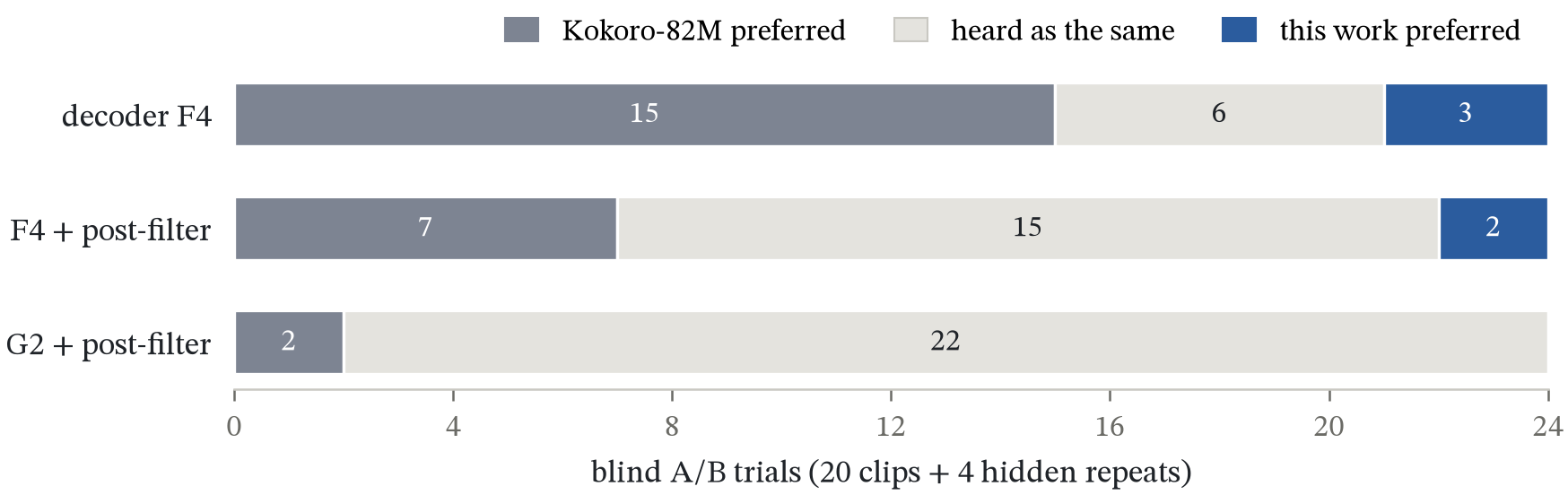
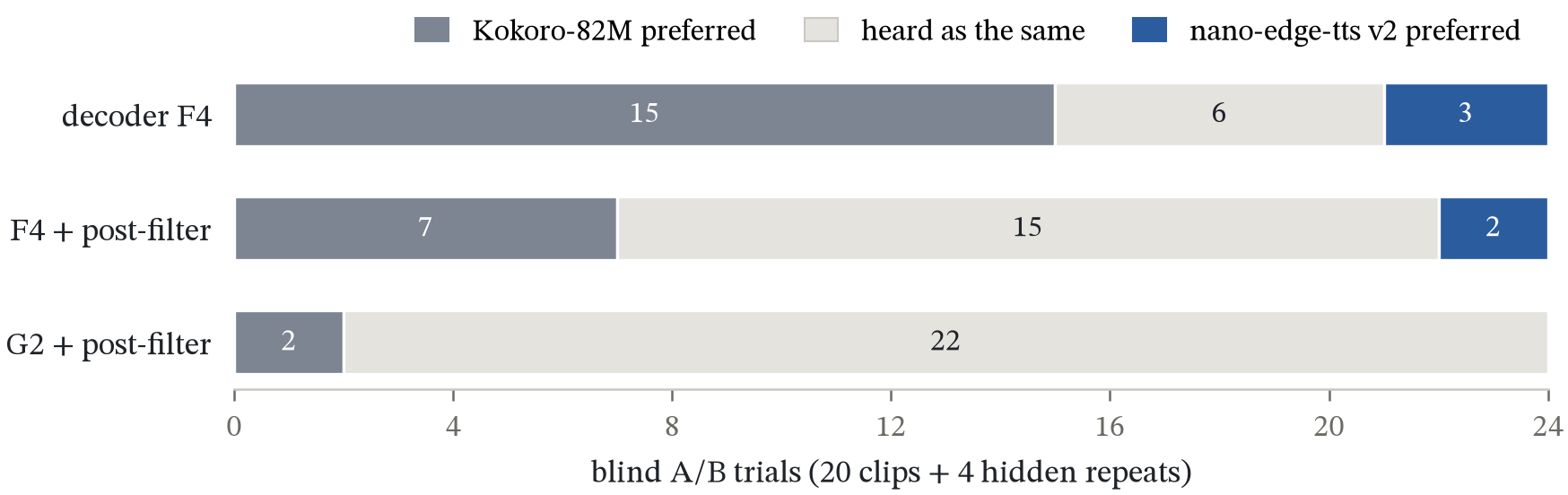
|
| 80 |
fig, ax = plt.subplots(figsize=(W, 1.55))
|
| 81 |
for i, (_, c) in enumerate(pages):
|
| 82 |
x = 0
|
|
|
|
| 37 |
|
| 38 |
def params():
|
| 39 |
rows = [('Kokoro-82M', [('text side', 28.5, KOK_LIGHT), ('decoder', 53.3, KOK_DARK)], '81.8M'),
|
| 40 |
+
('nano-edge-tts v1', [('Kokoro\'s text side', 28.5, KOK_LIGHT), ('', 1.75, BLUE_MID)], '30.2M new decoder 1.75M'),
|
| 41 |
+
('nano-edge-tts v2', [('', 1.52, BLUE_DARK), ('', 0.96, BLUE_MID), ('', 0.79, BLUE_LIGHT)],
|
| 42 |
'3.27M text side 1.52M · mapper 0.96M · renderer 0.79M')]
|
| 43 |
fig, ax = plt.subplots(figsize=(W, 1.65))
|
| 44 |
for i, (_, parts, total) in enumerate(rows):
|
|
|
|
| 76 |
('F4 + post-filter', count(os.path.join(RES, 'listening_F4sharp_vs_kokoro.json'))),
|
| 77 |
('G2 + post-filter', count(os.path.join(RES, 'listening_G2sharp_vs_kokoro.json')))]
|
| 78 |
keys = (('k', KOK_DARK, 'Kokoro-82M preferred', True), ('s', SAME, 'heard as the same', False),
|
| 79 |
+
('n', BLUE_DARK, 'nano-edge-tts v2 preferred', True))
|
| 80 |
fig, ax = plt.subplots(figsize=(W, 1.55))
|
| 81 |
for i, (_, c) in enumerate(pages):
|
| 82 |
x = 0
|
paper/figures/offsets.svg
CHANGED
|
|
paper/figures/params.png
CHANGED
|
|
paper/figures/params.svg
CHANGED
|
|
paper/paper.pdf
CHANGED
|
@@ -1,3 +1,3 @@
|
|
| 1 |
version https://git-lfs.github.com/spec/v1
|
| 2 |
-
oid sha256:
|
| 3 |
-
size
|
|
|
|
| 1 |
version https://git-lfs.github.com/spec/v1
|
| 2 |
+
oid sha256:10e5c694f1e7caed91f1b1d7bdb69b3711a5e191742425af3f4cc7b8b9457a7b
|
| 3 |
+
size 227707
|
paper/paper.typ
CHANGED
|
@@ -85,18 +85,18 @@
|
|
| 85 |
Kokoro-82M @kokoro is an 81.8M-parameter text-to-speech model built on StyleTTS 2 @styletts2: a 28.5M-parameter text side
|
| 86 |
(PL-BERT @plbert, a text encoder and a prosody predictor) turns phonemes and a voice vector into per-phoneme features, durations,
|
| 87 |
pitch and energy, and a 53.3M-parameter decoder turns those into a 24 kHz waveform. It tops the Open TTS Leaderboard's English
|
| 88 |
-
ranking @ttsleaderboard for both word error and predicted naturalness. nano-edge-tts @nanoedge
|
| 89 |
1.75M parameters that run no network at audio rate. That left the text side as 94% of the pipeline's parameters and 69% of its
|
| 90 |
CPU time.
|
| 91 |
|
| 92 |
-
This paper asks how much of the remaining capacity the quality actually needs, and answers: about 4%. The model described here
|
| 93 |
-
(@fig-params) runs a 1.52M-parameter text side into a 1.75M-parameter decoder of
|
| 94 |
it keeps only data: the 178-symbol phoneme vocabulary, the 28 English voice vectors, and the misaki front end @misaki, packaged
|
| 95 |
so that none of Kokoro's software is installed. Every component is distilled from Kokoro-82M, and closeness to Kokoro is the
|
| 96 |
target throughout.
|
| 97 |
|
| 98 |
#figure(image("figures/params.svg", width: 96%),
|
| 99 |
-
caption: [Learned parameters. Grey: Kokoro-82M's networks; blue: networks trained
|
| 100 |
renderer's fixed STFT matrices are buffers and are not counted.]) <fig-params>
|
| 101 |
|
| 102 |
The size reduction rests on three findings, each of which replaced a larger model or a longer training run with information
|
|
@@ -122,7 +122,7 @@ encoders of that kind. Kokoro adds PL-BERT @plbert, a phoneme-level language mod
|
|
| 122 |
side keeps the interface and replaces the language model with two cheap sources of context: part-of-speech tags and parameter
|
| 123 |
sharing across depth, as in ALBERT @albert and Universal Transformers @universal.
|
| 124 |
|
| 125 |
-
*Harmonic-plus-noise decoders.* The decoder is that of nano-edge-tts @nanoedge, in the line of spectral modelling synthesis
|
| 126 |
@sms, DDSP @ddsp and neural source-filter models @nsf; its critic reads frozen WavLM layers @wavlm as in StyleTTS 2. New here are
|
| 127 |
a second critic on the 4--12 kHz spectrogram, trained as a least-squares GAN @lsgan with feature matching @melgan, and an
|
| 128 |
inference-time post-filter on the noise gains, a frequency-domain cousin of the adaptive postfilters of speech coding @postfilter.
|
|
@@ -149,11 +149,11 @@ The text side has the interface of Kokoro's: phoneme ids and the prosody half of
|
|
| 149 |
A mapper (0.96M) turns per-phoneme features, F0 and energy into a 512-channel description at 80 frames per second; a renderer
|
| 150 |
(0.79M) predicts, 160 times a second, a gain and a phase rotation for each of 301 bins of a pulse train's STFT (25 ms window) and
|
| 151 |
a gain for each of 61 bins of white noise's STFT (5 ms window) at five sub-steps. Two inverse STFTs make the audio; no network runs
|
| 152 |
-
at audio rate. Four changes to
|
| 153 |
|
| 154 |
- *Cached mapper.* The mapper is trained with the renderer on whole sentences, then frozen and its features cached per training
|
| 155 |
window. The WavLM critic is the only adversary; the multi-period and multi-resolution discriminators cost most of each step and
|
| 156 |
-
added little. A renderer step fell from 868 to 212 ms.
|
| 157 |
- *Expected power.* Spectral losses compare Kokoro's spectrum with the output's expected power, $|H|^2 + EE|N|^2$, over four noise
|
| 158 |
draws. Against one draw the noise branch is charged for its own fluctuation, and the exact-period harmonic branch takes over the
|
| 159 |
high band, which listeners heard as "machine".
|
|
|
|
| 85 |
Kokoro-82M @kokoro is an 81.8M-parameter text-to-speech model built on StyleTTS 2 @styletts2: a 28.5M-parameter text side
|
| 86 |
(PL-BERT @plbert, a text encoder and a prosody predictor) turns phonemes and a voice vector into per-phoneme features, durations,
|
| 87 |
pitch and energy, and a 53.3M-parameter decoder turns those into a 24 kHz waveform. It tops the Open TTS Leaderboard's English
|
| 88 |
+
ranking @ttsleaderboard for both word error and predicted naturalness. Our earlier model, nano-edge-tts v1 @nanoedge, replaced its decoder with
|
| 89 |
1.75M parameters that run no network at audio rate. That left the text side as 94% of the pipeline's parameters and 69% of its
|
| 90 |
CPU time.
|
| 91 |
|
| 92 |
+
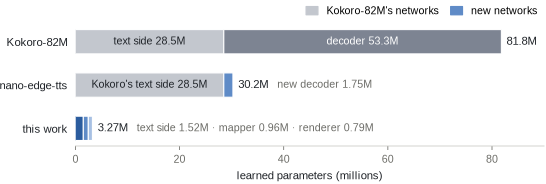
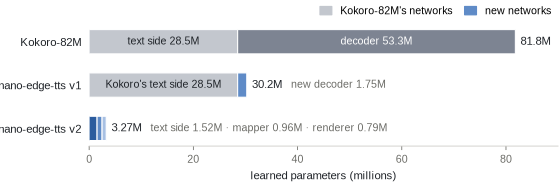
This paper presents nano-edge-tts v2 and asks how much of the remaining capacity the quality actually needs, and answers: about 4%. The model described here
|
| 93 |
+
(@fig-params) runs a 1.52M-parameter text side into a 1.75M-parameter decoder of v1's design, retrained. From Kokoro
|
| 94 |
it keeps only data: the 178-symbol phoneme vocabulary, the 28 English voice vectors, and the misaki front end @misaki, packaged
|
| 95 |
so that none of Kokoro's software is installed. Every component is distilled from Kokoro-82M, and closeness to Kokoro is the
|
| 96 |
target throughout.
|
| 97 |
|
| 98 |
#figure(image("figures/params.svg", width: 96%),
|
| 99 |
+
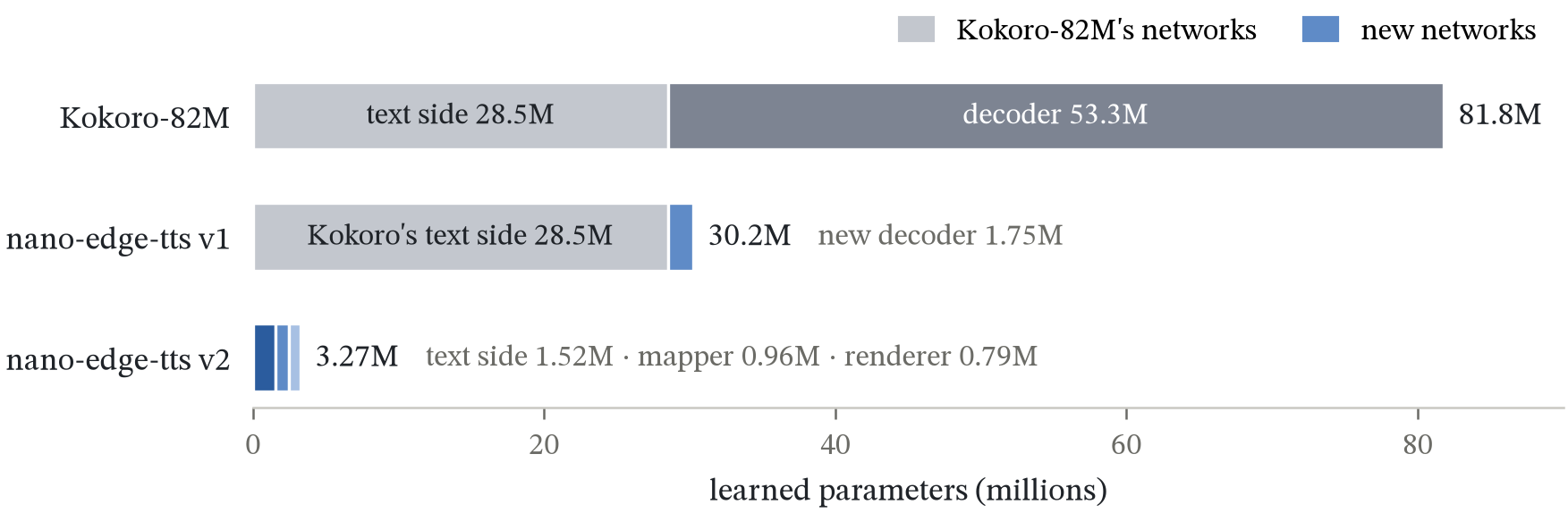
caption: [Learned parameters. Grey: Kokoro-82M's networks; blue: networks trained for nano-edge-tts v1 @nanoedge or v2. The
|
| 100 |
renderer's fixed STFT matrices are buffers and are not counted.]) <fig-params>
|
| 101 |
|
| 102 |
The size reduction rests on three findings, each of which replaced a larger model or a longer training run with information
|
|
|
|
| 122 |
side keeps the interface and replaces the language model with two cheap sources of context: part-of-speech tags and parameter
|
| 123 |
sharing across depth, as in ALBERT @albert and Universal Transformers @universal.
|
| 124 |
|
| 125 |
+
*Harmonic-plus-noise decoders.* The decoder is that of nano-edge-tts v1 @nanoedge, in the line of spectral modelling synthesis
|
| 126 |
@sms, DDSP @ddsp and neural source-filter models @nsf; its critic reads frozen WavLM layers @wavlm as in StyleTTS 2. New here are
|
| 127 |
a second critic on the 4--12 kHz spectrogram, trained as a least-squares GAN @lsgan with feature matching @melgan, and an
|
| 128 |
inference-time post-filter on the noise gains, a frequency-domain cousin of the adaptive postfilters of speech coding @postfilter.
|
|
|
|
| 149 |
A mapper (0.96M) turns per-phoneme features, F0 and energy into a 512-channel description at 80 frames per second; a renderer
|
| 150 |
(0.79M) predicts, 160 times a second, a gain and a phase rotation for each of 301 bins of a pulse train's STFT (25 ms window) and
|
| 151 |
a gain for each of 61 bins of white noise's STFT (5 ms window) at five sub-steps. Two inverse STFTs make the audio; no network runs
|
| 152 |
+
at audio rate. Four changes to v1's training made a step four times faster and removed its buzz:
|
| 153 |
|
| 154 |
- *Cached mapper.* The mapper is trained with the renderer on whole sentences, then frozen and its features cached per training
|
| 155 |
window. The WavLM critic is the only adversary; the multi-period and multi-resolution discriminators cost most of each step and
|
| 156 |
+
added little in v1. A renderer step fell from 868 to 212 ms.
|
| 157 |
- *Expected power.* Spectral losses compare Kokoro's spectrum with the output's expected power, $|H|^2 + EE|N|^2$, over four noise
|
| 158 |
draws. Against one draw the noise branch is charged for its own fluctuation, and the exact-period harmonic branch takes over the
|
| 159 |
high band, which listeners heard as "machine".
|