

Paper: describes the model as it is (training stages, not release versions)
Browse files- README.md +2 -2
- paper/figures/listening.png +0 -0
- paper/figures/listening.svg +99 -99
- paper/figures/make.py +5 -5
- paper/figures/offsets.png +0 -0
- paper/figures/offsets.svg +61 -61
- paper/figures/params.png +0 -0
- paper/figures/params.svg +80 -80
- paper/paper.pdf +2 -2
- paper/paper.typ +49 -50
README.md
CHANGED
|
@@ -32,8 +32,8 @@ learned is new:
|
|
| 32 |
|
| 33 |

|
| 34 |
|
| 35 |
-
**Paper:** [Kokoro-82M in 3.3M Parameters: A Small Text Side and a Frame-Rate Decoder, Reproducible End to End](paper/paper.pdf)
|
| 36 |
-
|
| 37 |
the exact code, and one script from public books to these weights ([`code/`](code)).
|
| 38 |
|
| 39 |
| | Kokoro-82M | v2.0 | v2.1 (this) |
|
|
|
|
| 32 |
|
| 33 |

|
| 34 |
|
| 35 |
+
**Paper:** [Kokoro-82M in 3.3M Parameters: A Small Text Side and a Frame-Rate Decoder, Reproducible End to End](paper/paper.pdf).
|
| 36 |
+
**To rebuild it:** every checkpoint of the training chain with its arguments and logs ([`chain/`](chain)),
|
| 37 |
the exact code, and one script from public books to these weights ([`code/`](code)).
|
| 38 |
|
| 39 |
| | Kokoro-82M | v2.0 | v2.1 (this) |
|
paper/figures/listening.png
CHANGED
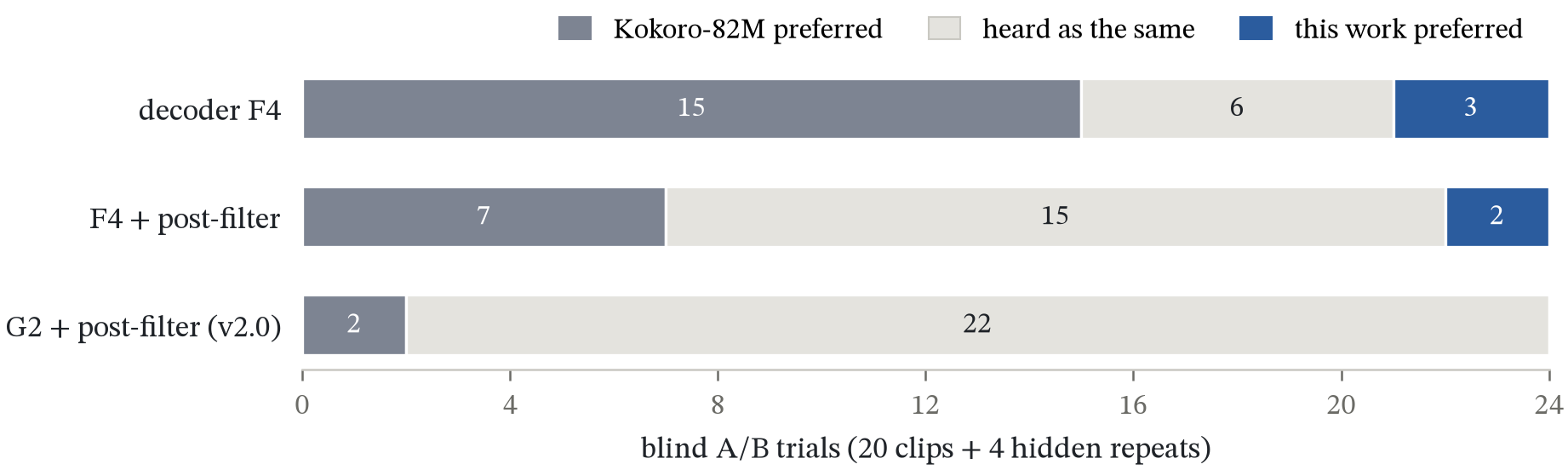
|
|
paper/figures/listening.svg
CHANGED
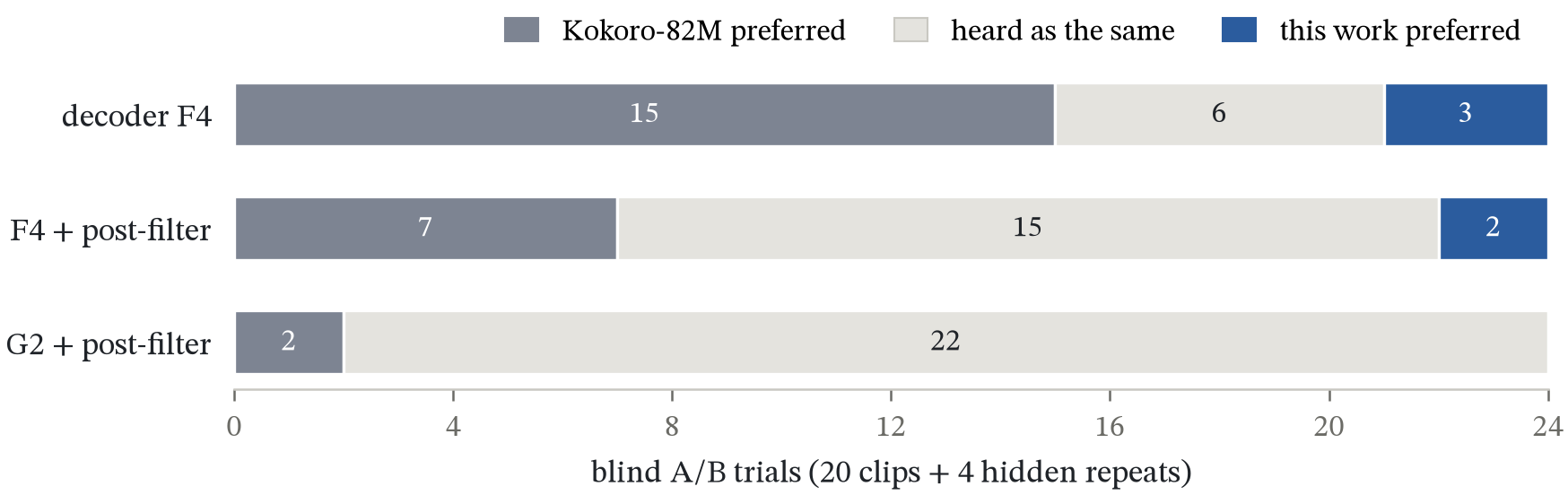
|
|
paper/figures/make.py
CHANGED
|
@@ -1,6 +1,6 @@
|
|
| 1 |
"""Figures for paper_v2: parameter counts, the listening tests against Kokoro-82M, and the voice measures per decoder version.
|
| 2 |
python paper_v2/figures/make.py (reads release_v2/results; writes paper_v2/figures/*.svg for the paper, *.png for the card)
|
| 3 |
-
One colour scheme throughout: greys are Kokoro-82M, blues are this work's models, orange marks the
|
| 4 |
import json
|
| 5 |
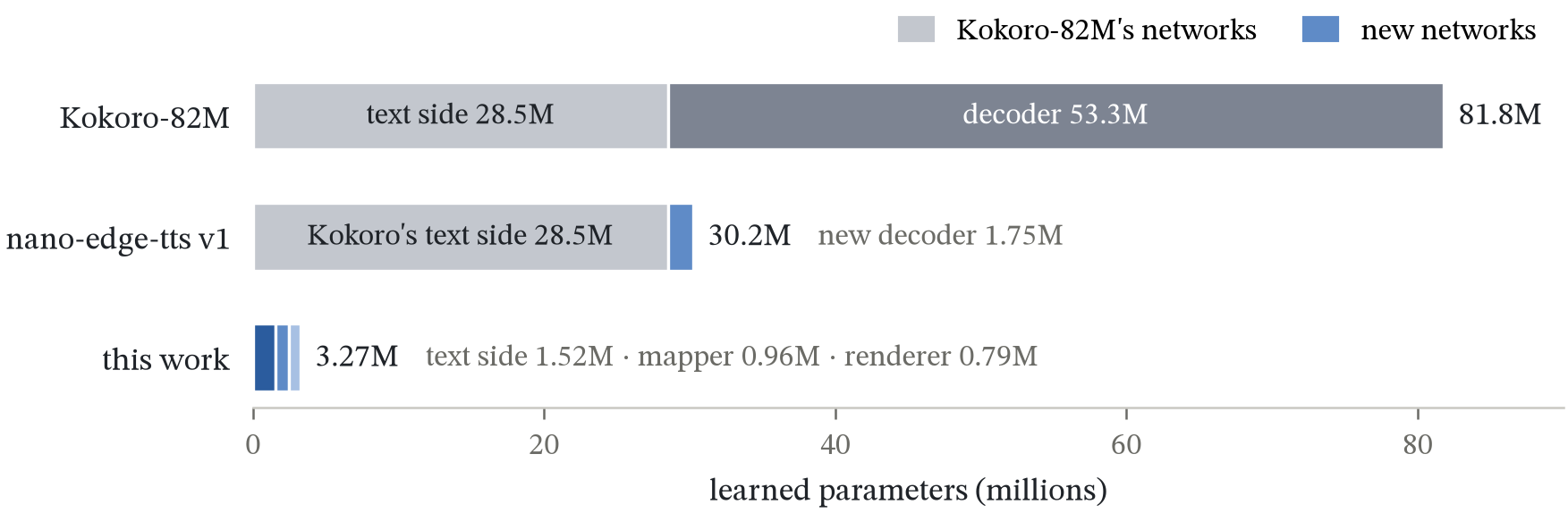
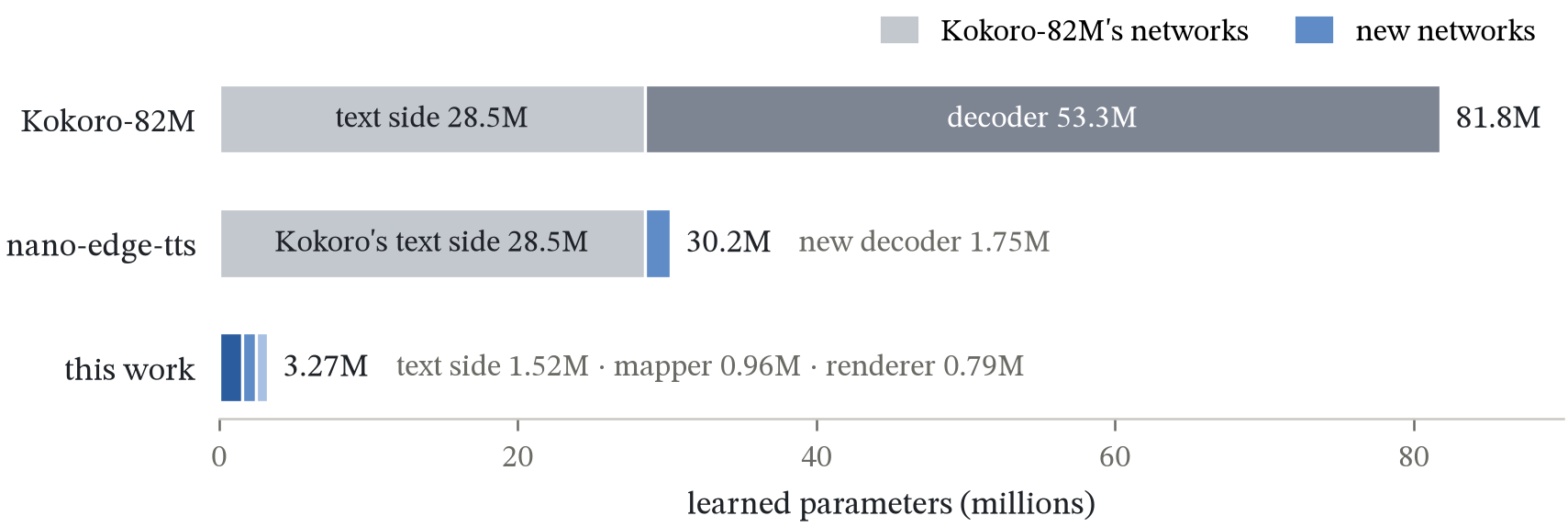
import os
|
| 6 |
|
|
@@ -37,7 +37,7 @@ def bar_label(ax, x, y, s, dark):
|
|
| 37 |
|
| 38 |
def params():
|
| 39 |
rows = [('Kokoro-82M', [('text side', 28.5, KOK_LIGHT), ('decoder', 53.3, KOK_DARK)], '81.8M'),
|
| 40 |
-
('nano-edge-tts
|
| 41 |
('this work', [('', 1.52, BLUE_DARK), ('', 0.96, BLUE_MID), ('', 0.79, BLUE_LIGHT)],
|
| 42 |
'3.27M text side 1.52M · mapper 0.96M · renderer 0.79M')]
|
| 43 |
fig, ax = plt.subplots(figsize=(W, 1.65))
|
|
@@ -74,7 +74,7 @@ def count(path, nano='nano4M'):
|
|
| 74 |
def listening():
|
| 75 |
pages = [('decoder F4', count(os.path.join(RES, 'listening_F4_vs_kokoro.json'))),
|
| 76 |
('F4 + post-filter', count(os.path.join(RES, 'listening_F4sharp_vs_kokoro.json'))),
|
| 77 |
-
('G2 + post-filter
|
| 78 |
keys = (('k', KOK_DARK, 'Kokoro-82M preferred', True), ('s', SAME, 'heard as the same', False),
|
| 79 |
('n', BLUE_DARK, 'this work preferred', True))
|
| 80 |
fig, ax = plt.subplots(figsize=(W, 1.55))
|
|
@@ -99,8 +99,8 @@ def offsets():
|
|
| 99 |
('breath_top_4-6k', 'breath 4–6 kHz'), ('breath_all_3-4k', 'breath 3–4 kHz'),
|
| 100 |
('flutter_100-500', 'flutter 0.1–0.5 kHz'), ('flutter_4000-8000', 'flutter 4–8 kHz'), ('crackle', 'crackle')]
|
| 101 |
vers = [('e2e_F4', 'F4', BLUE_LIGHT, 'o'), ('e2e_F4_sharp', 'F4 + post-filter', BLUE_MID, 's'),
|
| 102 |
-
('e2e_G2_t6_hb_sharp', 'G2 + post-filter
|
| 103 |
-
('e2e_FT4_G3_ft4_hb_sharp', 'FT4 + G3 (
|
| 104 |
fig, ax = plt.subplots(figsize=(W, 2.9))
|
| 105 |
for i in range(len(stats)):
|
| 106 |
if i % 2 == 0:
|
|
|
|
| 1 |
"""Figures for paper_v2: parameter counts, the listening tests against Kokoro-82M, and the voice measures per decoder version.
|
| 2 |
python paper_v2/figures/make.py (reads release_v2/results; writes paper_v2/figures/*.svg for the paper, *.png for the card)
|
| 3 |
+
One colour scheme throughout: greys are Kokoro-82M, blues are this work's models, orange marks the published model."""
|
| 4 |
import json
|
| 5 |
import os
|
| 6 |
|
|
|
|
| 37 |
|
| 38 |
def params():
|
| 39 |
rows = [('Kokoro-82M', [('text side', 28.5, KOK_LIGHT), ('decoder', 53.3, KOK_DARK)], '81.8M'),
|
| 40 |
+
('nano-edge-tts', [('Kokoro\'s text side', 28.5, KOK_LIGHT), ('', 1.75, BLUE_MID)], '30.2M new decoder 1.75M'),
|
| 41 |
('this work', [('', 1.52, BLUE_DARK), ('', 0.96, BLUE_MID), ('', 0.79, BLUE_LIGHT)],
|
| 42 |
'3.27M text side 1.52M · mapper 0.96M · renderer 0.79M')]
|
| 43 |
fig, ax = plt.subplots(figsize=(W, 1.65))
|
|
|
|
| 74 |
def listening():
|
| 75 |
pages = [('decoder F4', count(os.path.join(RES, 'listening_F4_vs_kokoro.json'))),
|
| 76 |
('F4 + post-filter', count(os.path.join(RES, 'listening_F4sharp_vs_kokoro.json'))),
|
| 77 |
+
('G2 + post-filter', count(os.path.join(RES, 'listening_G2sharp_vs_kokoro.json')))]
|
| 78 |
keys = (('k', KOK_DARK, 'Kokoro-82M preferred', True), ('s', SAME, 'heard as the same', False),
|
| 79 |
('n', BLUE_DARK, 'this work preferred', True))
|
| 80 |
fig, ax = plt.subplots(figsize=(W, 1.55))
|
|
|
|
| 99 |
('breath_top_4-6k', 'breath 4–6 kHz'), ('breath_all_3-4k', 'breath 3–4 kHz'),
|
| 100 |
('flutter_100-500', 'flutter 0.1–0.5 kHz'), ('flutter_4000-8000', 'flutter 4–8 kHz'), ('crackle', 'crackle')]
|
| 101 |
vers = [('e2e_F4', 'F4', BLUE_LIGHT, 'o'), ('e2e_F4_sharp', 'F4 + post-filter', BLUE_MID, 's'),
|
| 102 |
+
('e2e_G2_t6_hb_sharp', 'G2 + post-filter', BLUE_DARK, 'D'),
|
| 103 |
+
('e2e_FT4_G3_ft4_hb_sharp', 'FT4 + G3 (published)', RELEASE, '^')]
|
| 104 |
fig, ax = plt.subplots(figsize=(W, 2.9))
|
| 105 |
for i in range(len(stats)):
|
| 106 |
if i % 2 == 0:
|
paper/figures/offsets.png
CHANGED
|
|
paper/figures/offsets.svg
CHANGED
|
|
paper/figures/params.png
CHANGED
|
|
paper/figures/params.svg
CHANGED
|
|
paper/paper.pdf
CHANGED
|
@@ -1,3 +1,3 @@
|
|
| 1 |
version https://git-lfs.github.com/spec/v1
|
| 2 |
-
oid sha256:
|
| 3 |
-
size
|
|
|
|
| 1 |
version https://git-lfs.github.com/spec/v1
|
| 2 |
+
oid sha256:236da42695b18dc831f0fe2cc2ee59fe1f424e02c46c3908d81f8a0068491d16
|
| 3 |
+
size 236698
|
paper/paper.typ
CHANGED
|
@@ -56,7 +56,7 @@
|
|
| 56 |
#v(1.1em)
|
| 57 |
#text(11.5pt)[Mike Chumba]
|
| 58 |
#v(0.3em)
|
| 59 |
-
#text(9pt, fill: muted)[#link("https://huggingface.co/drmhse/nano-edge-tts-standalone")[huggingface.co/drmhse/nano-edge-tts-standalone] #h(0.5em)·#h(0.5em) November 2026
|
| 60 |
]
|
| 61 |
#v(0.8em)
|
| 62 |
#block(inset: (x: 1.1cm))[
|
|
@@ -69,10 +69,10 @@
|
|
| 69 |
then discards, and from one attention block run four times over words and twice over phonemes. The decoder was retrained with a
|
| 70 |
recipe that takes hours instead of days; its last audible fault, a flat high band, was traced to the noise gains regressing to
|
| 71 |
their mean, and a three-line post-filter plus a fine-tune on the small text side's own features took a blind A/B against
|
| 72 |
-
Kokoro-82M from 15 Kokoro wins, 6 ties and 3 losses in 24 trials to 2, 22 and 0. A
|
| 73 |
-
|
| 74 |
time put the fault in the per-phoneme features, spread over the phonemes around a rare vowel; measuring their error through the
|
| 75 |
-
decoder's own frozen mapper raised the rate to 78.8% in one hour of fine-tuning, and
|
| 76 |
features raised UTMOS from 4.451 to 4.467 without an audible change. Kokoro's front end is packaged as data and plain
|
| 77 |
Python, with the same word error as Kokoro's own on the Open TTS Leaderboard's English sets. On one CPU thread the model runs 28
|
| 78 |
times faster than Kokoro-82M in 0.71 GB (31 times in 0.60 GB with ONNX Runtime), with 35 Whisper word errors on 60 unseen sentences against Kokoro's 36. Every
|
|
@@ -90,12 +90,12 @@ second, 1.75M parameters in all. That left the text side as 94% of the pipeline'
|
|
| 90 |
|
| 91 |
This paper removes it. The model described here (@fig-params) runs no Kokoro network at all: a 1.52M-parameter text side feeds a
|
| 92 |
retrained 1.75M-parameter decoder of the same design. What it keeps from Kokoro is data, not computation: the misaki
|
| 93 |
-
grapheme-to-phoneme front end @misaki (packaged
|
| 94 |
the 178-symbol phoneme vocabulary, and the 28 English voice vectors. Kokoro-82M is the
|
| 95 |
teacher throughout, and closeness to Kokoro is the target, measured by ear and by reference-free statistics.
|
| 96 |
|
| 97 |
#figure(image("figures/params.svg", width: 96%),
|
| 98 |
-
caption: [Learned parameters. Grey: Kokoro-82M's networks; blue: networks trained here or in nano-edge-tts
|
| 99 |
fixed STFT matrices are buffers and are not counted.]) <fig-params>
|
| 100 |
|
| 101 |
The contributions are:
|
|
@@ -109,7 +109,7 @@ The contributions are:
|
|
| 109 |
- A diagnosis of the last audible gap, a flat 4--8 kHz band: about a third is the noise branch's 5 ms analysis window, two thirds
|
| 110 |
are its learned gains averaging toward their mean; loss weight on that band moved the loss but not the sound, and a post-filter
|
| 111 |
of the kind speech codecs use @postfilter closed most of the audible gap (@sec-highband).
|
| 112 |
-
-
|
| 113 |
fine-tune whose loss measures the text side's features through the decoder's frozen mapper, as the decoder hears them
|
| 114 |
(@sec-ft). Target words said rose from 59.3% to 78.8% (Kokoro 81.8%).
|
| 115 |
- Kokoro's front end without its dependencies: spaCy's tagger as exported data, misaki's rules, and espeak-ng's answers for
|
|
@@ -159,12 +159,12 @@ The text side has the interface of Kokoro's: phoneme ids and the prosody half of
|
|
| 159 |
The decoder is nano-edge-tts's: a mapper (0.96M) turns per-phoneme features, F0 and energy into a 512-channel description at 80
|
| 160 |
frames per second; a renderer (0.79M) predicts, 160 times a second, a gain and a phase rotation for each of 301 bins of a pulse
|
| 161 |
train's STFT (25 ms window) and a gain for each of 61 bins of white noise's STFT (5 ms window) at five sub-steps. Two inverse STFTs
|
| 162 |
-
make the audio. It was retrained from scratch for this
|
| 163 |
that removed buzz:
|
| 164 |
|
| 165 |
- *Speed.* The mapper is trained with the renderer on whole sentences batched by length, then frozen and its features cached for
|
| 166 |
every training window; Kokoro's audio for each window is cut from whole-sentence decodes once. The only adversary is the WavLM
|
| 167 |
-
critic (the multi-period and multi-resolution discriminators of
|
| 168 |
Spectral losses share one STFT per batch. A renderer step fell from 868 to 212 ms.
|
| 169 |
- *Expected power.* Per-bin spectral and energy losses compare Kokoro's spectrum with the expected power of the output,
|
| 170 |
$|H|^2 + EE|N|^2$, averaged over four noise draws, not with one random draw. With one draw, the noise branch is charged for its
|
|
@@ -194,23 +194,23 @@ few pooling operations.
|
|
| 194 |
The decoder is trained on Kokoro's text-side features, but at inference it receives the small text side's. A last stage (G2)
|
| 195 |
fine-tunes it for 10k steps on the small text side's features, laid on Kokoro's durations so that Kokoro's F0, energy and audio
|
| 196 |
still line up, with a second critic on the 4--12 kHz log spectrogram at two resolutions (82k parameters). The WavLM critic
|
| 197 |
-
resamples to 16 kHz and cannot hear above 8 kHz.
|
| 198 |
-
features (G3
|
| 199 |
|
| 200 |
-
== Fine-tuning the text side through the decoder
|
| 201 |
|
| 202 |
The text side's feature loss is an L1 averaged over 512 channels and every phoneme. A rare phoneme barely weighs in it, and not
|
| 203 |
every channel matters to the decoder equally. The fine-tune (FT4) keeps the text side's losses and adds one: our features and
|
| 204 |
-
Kokoro's, each laid on Kokoro's durations, go through
|
| 205 |
two outputs in the mapper's normalised units, at every frame. Its data are T6's sentences plus 30,000 more, drawn four times as
|
| 206 |
often: 10,000 lines of 4--29 characters (the text side had seen none under 30), 8,000 questions and exclamations, and 12,000
|
| 207 |
sentences holding the rarest sounds (/ɔɪ/ 0.62 and /ʒ/ 0.28 per 1,000 phonemes), from 22 public-domain novels used nowhere else.
|
| 208 |
It starts from T6 and runs 4,000 steps at learning rate 3e-4, with the decoder unchanged; G3 then fits the decoder to it.
|
| 209 |
|
| 210 |
-
== A front end without dependencies
|
| 211 |
|
| 212 |
Kokoro turns text into phonemes with misaki, which needs spaCy, a spaCy model and espeak-ng, a GPL system library it calls for
|
| 213 |
-
words outside its lexicons.
|
| 214 |
accents, against 87 MB installed for Kokoro's): spaCy's tokenizer rules and tagger weights exported and run in numpy, misaki's code
|
| 215 |
with its lexicons, and number reading. For unknown words, misaki asks espeak-ng about the token alone, and espeak-ng ignores letter
|
| 216 |
case, so its answers can be computed once: for 915,000 words (CMUdict's words, US name lists, English Wikipedia words seen 20 times
|
|
@@ -242,13 +242,13 @@ set (_The War of the Worlds_, _Walden_, _The Scarlet Letter_), four per voice; e
|
|
| 242 |
[G3], [G2; FT4's features, same recipe], [10,000], [1.6 h],
|
| 243 |
hl),
|
| 244 |
caption: [The training chain on one Apple-silicon laptop GPU. Each decoder stage starts from the previous checkpoint with its
|
| 245 |
-
critics. The post-filter is set on F4, G2 and G3 at export.
|
| 246 |
(Kokoro's targets for 134k sentences) adds several hours.]) <tab-chain>
|
| 247 |
|
| 248 |
*Reproducibility.* The release holds every checkpoint in @tab-chain (with optimiser and critic states, so any stage can be
|
| 249 |
resumed), the ablations of @tab-text, each run's recorded arguments and training log, the exact code, and `reproduce_v2.sh`,
|
| 250 |
-
which downloads Kokoro-82M and the books and runs every stage with the recorded arguments, skipping what exists.
|
| 251 |
-
|
| 252 |
Kokoro's features agree to float16 precision. GPU training is not bit-deterministic, so a rerun reproduces the recipe, not the
|
| 253 |
exact weights; the published intermediate checkpoints let any single stage be rerun and compared. Resuming F4 from
|
| 254 |
the published F3 checkpoint with the published code gives the original run's losses to three decimals over 200 steps
|
|
@@ -271,23 +271,24 @@ leaderboard's own transcription and UTMOS pipeline, run locally on one CPU threa
|
|
| 271 |
= Results
|
| 272 |
|
| 273 |
#figure(table(columns: 4, align: (left, right, right, right),
|
| 274 |
-
hl, [], [Kokoro-82M], [
|
| 275 |
thl,
|
| 276 |
[learned parameters], [81.8M], [3.27M], [3.27M],
|
| 277 |
[Kokoro networks run at inference], [all], [none], [none],
|
| 278 |
-
[Kokoro software installed], [misaki, spaCy, espeak-ng], [
|
| 279 |
-
[real-time factor, one CPU thread, phonemes to audio], [0.1415], [
|
| 280 |
[#h(1em) the same with ONNX Runtime], [], [], [0.0045],
|
| 281 |
-
[peak memory, whole pipeline with the front end], [1.78 GB], [
|
| 282 |
[#h(1em) the same with ONNX Runtime], [], [], [0.60 GB],
|
| 283 |
[Whisper word errors, 60 unseen sentences], [36], [39], [*35*],
|
| 284 |
[target words said (4,806)], [81.8%], [59.3%], [78.7%],
|
| 285 |
[leaderboard English sets: word error, UTMOS], [0.66%, 4.51], [0.77%, 4.441], [*0.71%*, 4.467],
|
| 286 |
-
[blind A/B against Kokoro-82M
|
| 287 |
hl),
|
| 288 |
-
caption: [The
|
|
|
|
| 289 |
laptop CPU. Leaderboard: ours run locally with the leaderboard's pipeline; Kokoro's as published (version 1.7.0, other
|
| 290 |
-
hardware). Kokoro's text side with
|
| 291 |
|
| 292 |
== The text side
|
| 293 |
|
|
@@ -298,8 +299,8 @@ leaderboard's own transcription and UTMOS pipeline, run locally on one CPU threa
|
|
| 298 |
[T2: the same, 92k sentences], [5.0M], [147], [.708], [.925],
|
| 299 |
[T5: + PL-BERT distillation, 6 attention layers], [8.15M], [134], [.737], [.934],
|
| 300 |
thl,
|
| 301 |
-
[T6: small, tags, shared attention
|
| 302 |
-
[FT4: T6 fine-tuned
|
| 303 |
[T7: T6 without tags], [1.52M], [153], [.702], [.920],
|
| 304 |
[T8: T6 + dependency parse], [1.55M], [139], [.712], [.929],
|
| 305 |
[T9: T6 at width 192], [0.93M], [179], [.652], [.898],
|
|
@@ -326,7 +327,7 @@ same decoder and on the 20 most expressive clips, were heard as no different. Th
|
|
| 326 |
caption: [Blind A/B, Kokoro-82M against the 3.27M model (T6 text side), on the same 20 expressive test clips, one page per
|
| 327 |
decoder. Clips marked dirty: 7 (F4), 0 (F4 + post-filter), 2 (G2 + post-filter, the two Kokoro won).]) <fig-listening>
|
| 328 |
|
| 329 |
-
The decoder alone was first judged against
|
| 330 |
dirty. With the small text side in front it lost clearly to Kokoro-82M (@fig-listening, top), and since the text side had been
|
| 331 |
heard as equal to Kokoro's, the gap was the decoder's. On the clips marked dirty Kokoro's audio was higher pitched and brighter,
|
| 332 |
and across all 60 test clips the brighter Kokoro was at 4--8 kHz, the further our contrast fell below it (Spearman $r = -.65$):
|
|
@@ -342,7 +343,7 @@ weighting the loss did not help, and what the post-filter undoes.
|
|
| 342 |
|
| 343 |
#figure(image("figures/offsets.svg", width: 96%),
|
| 344 |
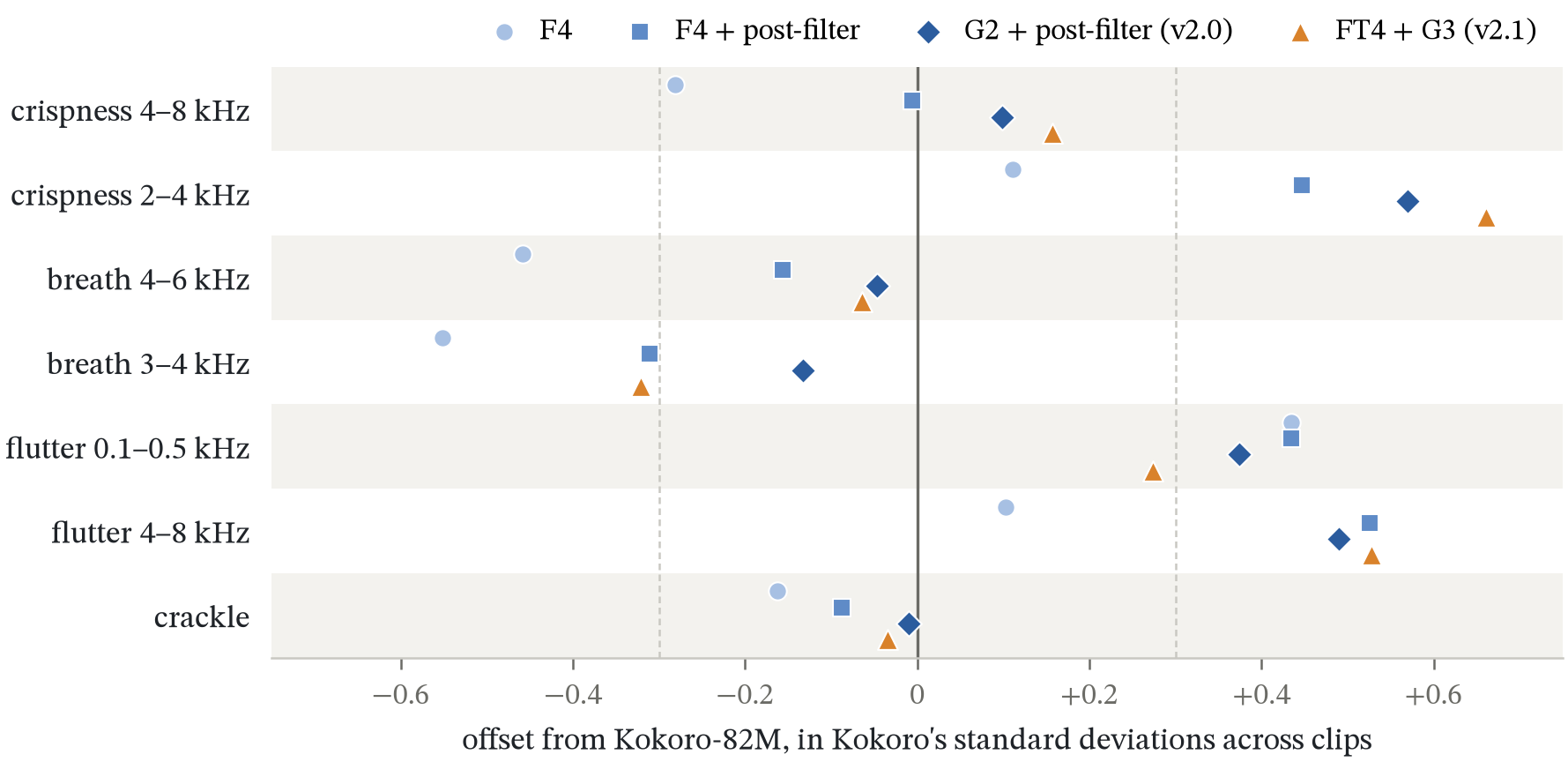
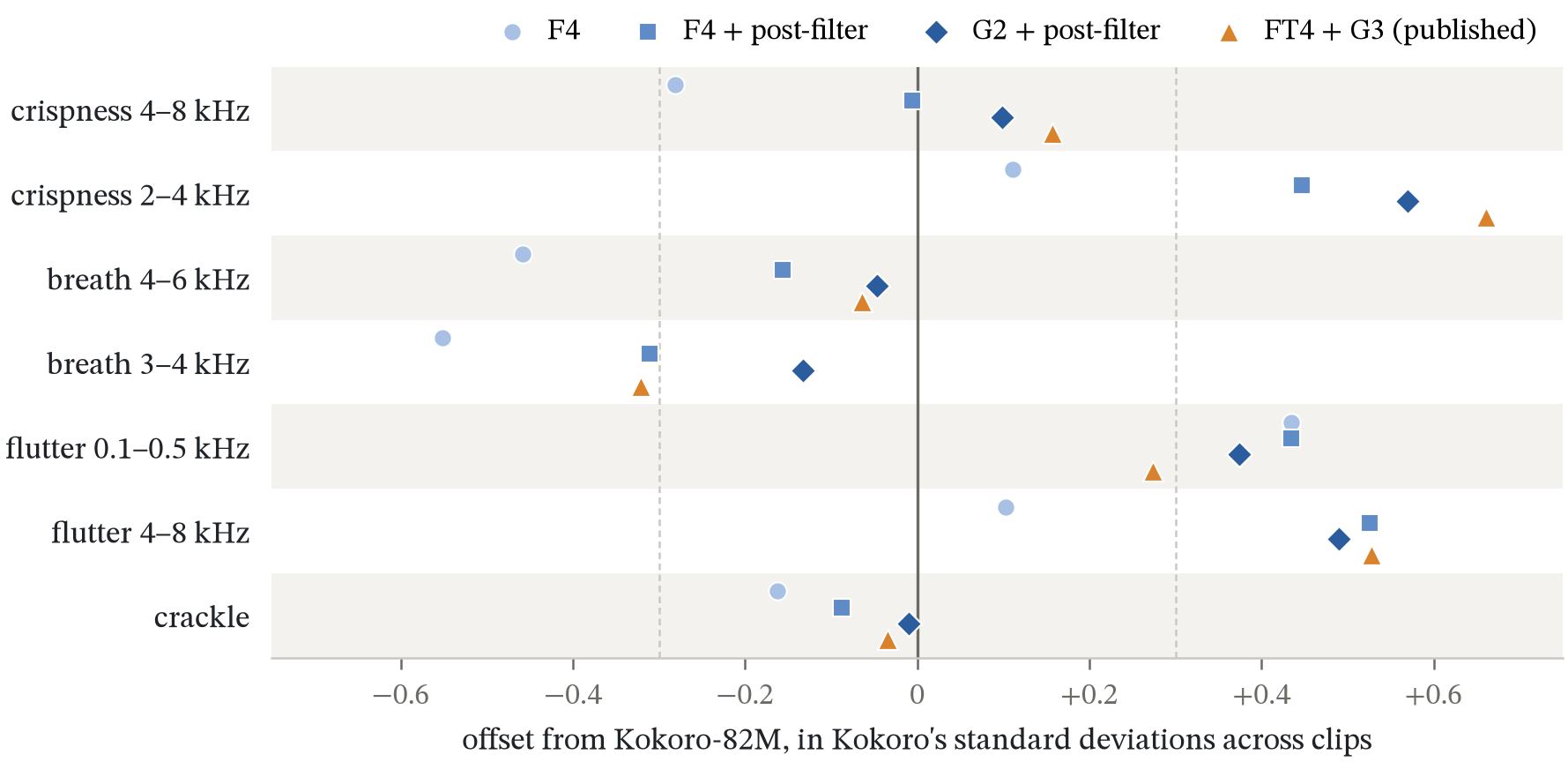
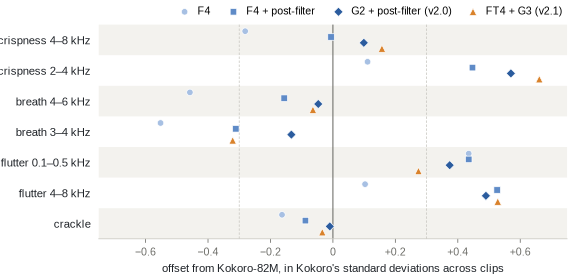
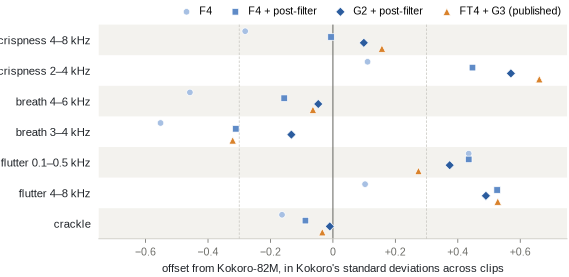
caption: [Reference-free voice measures on the 60 test sentences, as offsets from Kokoro-82M; dashed lines mark ±0.3. F4 and G2
|
| 345 |
-
with the T6 text side;
|
| 346 |
|
| 347 |
With the post-filter, 15 of 24 trials were heard as the same as Kokoro, 7 favoured Kokoro and 2 ours, all 4 repeats were answered
|
| 348 |
consistently, and no clip was marked dirty (@fig-listening). @fig-offsets shows what it trades: crispness and breath at 4--8 kHz
|
|
@@ -353,20 +354,19 @@ Fine-tuning on the small text side's features (G2) moved the mean absolute offse
|
|
| 353 |
post-filter) to .221 and the word errors to 39. Without the high-band critic (G1) the fine-tune gave nearly the same numbers: the
|
| 354 |
critic learned to separate our 4--12 kHz from Kokoro's, but the decoder did not close that gap in 10k steps. By ear G2 was the
|
| 355 |
largest step (@fig-listening): on the same page, 22 of 24 trials were heard as the same as Kokoro, Kokoro was preferred on two
|
| 356 |
-
clips (both also marked dirty; one of them had lost on the F4 page too), ours on none, and all 4 repeats were consistent.
|
| 357 |
-
with the post-filter was released as version 2.0, with F4 and the post-filter beside it (both kept at the tag `v2.0`).
|
| 358 |
|
| 359 |
A last observation about the interface: Kokoro's own decoder fed the small text side's output makes 59 word errors on the 60
|
| 360 |
sentences, against 39 for ours. A decoder trained alongside the text side it will receive is more forgiving of that text side
|
| 361 |
than the decoder it was distilled from.
|
| 362 |
|
| 363 |
-
== Words
|
| 364 |
|
| 365 |
#figure(table(columns: 4, align: (left, right, right, right),
|
| 366 |
hl, [text side (decoder G2 unless noted)], [targets said], [lost vs Kokoro], [of which /ɔɪ/ words],
|
| 367 |
thl,
|
| 368 |
[Kokoro-82M], [81.8%], [], [],
|
| 369 |
-
[T6
|
| 370 |
[T6, /ɔɪ/ respelled as ɔː + j in the front end], [70.4%], [686], [248],
|
| 371 |
thl,
|
| 372 |
[FT1: + 30,000 sentences ×4], [61.5%], [1,091], [705],
|
|
@@ -375,11 +375,11 @@ than the decoder it was distilled from.
|
|
| 375 |
[FT4: FT1 + loss through the frozen mapper], [78.8%], [335], [92],
|
| 376 |
[FT5: ×8, mapper loss ×3], [79.4%], [309], [87],
|
| 377 |
thl,
|
| 378 |
-
[*FT4 with decoder G3 (
|
| 379 |
hl),
|
| 380 |
caption: [The word test (4,806 targets, 27 voices, two recognisers). "Lost": targets Kokoro says and ours does not.]) <tab-words>
|
| 381 |
|
| 382 |
-
|
| 383 |
/ɔɪ/ targets of eight voices, Kokoro's text side with our decoder says 167 and ours with Kokoro's decoder 1: the text side loses
|
| 384 |
them. Giving our text side Kokoro's features alone (our durations, pitch and energy) brings 162; Kokoro's durations alone 4, its
|
| 385 |
pitch and energy alone 3. Kokoro's features at the /ɔɪ/ phoneme only bring 19, and with one phoneme either side 142: Kokoro's
|
|
@@ -388,35 +388,34 @@ and a heavier weight on the rare phoneme itself (FT3) did little (@tab-words). O
|
|
| 388 |
average phoneme's in L1; through the mapper the same features differed far more. The mapper loss fell from .118 to .075 while the
|
| 389 |
plain L1 hardly moved (.0991 to .0983), and the targets said rose to 78.8%. A front-end respelling of /ɔɪ/ that routed around the
|
| 390 |
fault (70.4%) is no longer needed and is slightly worse on top of FT4. FT5 gained 0.6 points more but its pitch error on Kokoro's
|
| 391 |
-
validation sentences rose 3.6 cents; FT4 was
|
| 392 |
than T6's (@tab-text).
|
| 393 |
|
| 394 |
-
By ear,
|
| 395 |
whose transcripts differ between the two (25 of 320 rendered: 40 sentences dense in the lost words, 8 voices). On ordinary
|
| 396 |
sentences the two are hard to tell apart: on 60 test-book sentences their transcripts were identical in 55, and in 4 of the 5
|
| 397 |
-
others
|
| 398 |
|
| 399 |
Fitting the decoder to FT4 (G3) left the words where they were (@tab-words) and raised UTMOS on all four leaderboard sets, to
|
| 400 |
4.467, with word error 0.71%. A page of 20 unseen sentences against FT4 + G2 was heard as the same in all 24 trials (4 hidden
|
| 401 |
-
repeats).
|
| 402 |
|
| 403 |
-
Two other changes were tried
|
| 404 |
@wav2vec2 pulled the text side's features away from Kokoro's (their error through the mapper rose by 70%) and cut the targets said
|
| 405 |
to 51.4%, where the same fine-tune without it kept 78.5%: the features learned to satisfy one recogniser through one decoder
|
| 406 |
-
rather than to carry speech. Closing the remaining
|
| 407 |
-
spectral gaps to Kokoro below about 1.5 dB (a stronger post-filter, more noise between mid-band harmonics) was not heard.
|
| 408 |
|
| 409 |
-
== The front end
|
| 410 |
|
| 411 |
Against Kokoro's front end on 594,183 words of book text (alternating accents) the packaged one gives identical tokens and tags
|
| 412 |
throughout and identical phonemes on 24,698 of 25,284 sentences; every difference is on a word that reaches the fallback (the
|
| 413 |
extra novels are among the table's sources, so this check is partly in sample). Compound tokens built from the vocabulary are read
|
| 414 |
-
exactly as Kokoro reads them in 581 of 600 sentences (American) and 570 (British). On the leaderboard sets, with
|
| 415 |
-
|
| 416 |
transcribed in the same run. Two cheaper variants failed that gate: a guess-only fallback (0.89%), and a table cut to Wikipedia
|
| 417 |
words seen 50 times or more (0.82%).
|
| 418 |
|
| 419 |
-
== Deployment
|
| 420 |
|
| 421 |
The model synthesises padded batches; their output differs from synthesis one sentence at a time by a fortieth of the
|
| 422 |
difference between two noise draws. On one CPU thread it runs at 189 times real time (median 43 ms per sentence; first audio of a long text in 153 ms),
|
|
@@ -429,8 +428,8 @@ reaches 223 times real time against PyTorch's 199. A `transformers` wrapper load
|
|
| 429 |
|
| 430 |
= Limitations
|
| 431 |
|
| 432 |
-
- *One listener.* No multi-listener test has been run.
|
| 433 |
-
|
| 434 |
- *Kokoro is the target.* Every part is trained to match Kokoro-82M's audio and prosody; at best the model sounds like Kokoro.
|
| 435 |
- *Borrowed parts.* The front end is still Kokoro's, carried as data, and the voices are Kokoro's 28 English voice vectors.
|
| 436 |
Other languages and voices have not been trained or tested. Words outside its lexicons and its 915,000 stored words are
|
|
@@ -447,8 +446,8 @@ Without running any of Kokoro-82M's networks, 3.27M parameters reproduce its spe
|
|
| 447 |
tried, a blind listener heard most pairs as the same. Two things did most of the work, and neither was capacity. In the text
|
| 448 |
side, accent placement came from part-of-speech tags that the front end already computed; a model a fifth of the size of the next
|
| 449 |
best one matched it once given them, and lost the advantage when they were taken away. In the decoder, the last audible gap was a
|
| 450 |
-
regression to the mean in the noise gains, which no loss weight moved and a parameter-free post-filter largely undid.
|
| 451 |
-
|
| 452 |
the way it is stored. The remaining gaps are measured, listed and published with every checkpoint that produced them, so that
|
| 453 |
each step can be checked, rerun or improved on.
|
| 454 |
|
|
|
|
| 56 |
#v(1.1em)
|
| 57 |
#text(11.5pt)[Mike Chumba]
|
| 58 |
#v(0.3em)
|
| 59 |
+
#text(9pt, fill: muted)[#link("https://huggingface.co/drmhse/nano-edge-tts-standalone")[huggingface.co/drmhse/nano-edge-tts-standalone] #h(0.5em)·#h(0.5em) November 2026]
|
| 60 |
]
|
| 61 |
#v(0.8em)
|
| 62 |
#block(inset: (x: 1.1cm))[
|
|
|
|
| 69 |
then discards, and from one attention block run four times over words and twice over phonemes. The decoder was retrained with a
|
| 70 |
recipe that takes hours instead of days; its last audible fault, a flat high band, was traced to the noise gains regressing to
|
| 71 |
their mean, and a three-line post-filter plus a fine-tune on the small text side's own features took a blind A/B against
|
| 72 |
+
Kokoro-82M from 15 Kokoro wins, 6 ties and 3 losses in 24 trials to 2, 22 and 0. A word test then exposed words it lost: of
|
| 73 |
+
4,806 targets checked by two recognisers it said 59.3%, Kokoro 81.8%. Swapping one text-side output at a
|
| 74 |
time put the fault in the per-phoneme features, spread over the phonemes around a rare vowel; measuring their error through the
|
| 75 |
+
decoder's own frozen mapper raised the rate to 78.8% in one hour of fine-tuning, and refitting the decoder to the new
|
| 76 |
features raised UTMOS from 4.451 to 4.467 without an audible change. Kokoro's front end is packaged as data and plain
|
| 77 |
Python, with the same word error as Kokoro's own on the Open TTS Leaderboard's English sets. On one CPU thread the model runs 28
|
| 78 |
times faster than Kokoro-82M in 0.71 GB (31 times in 0.60 GB with ONNX Runtime), with 35 Whisper word errors on 60 unseen sentences against Kokoro's 36. Every
|
|
|
|
| 90 |
|
| 91 |
This paper removes it. The model described here (@fig-params) runs no Kokoro network at all: a 1.52M-parameter text side feeds a
|
| 92 |
retrained 1.75M-parameter decoder of the same design. What it keeps from Kokoro is data, not computation: the misaki
|
| 93 |
+
grapheme-to-phoneme front end @misaki (packaged as data, so that none of Kokoro's software is installed, @sec-frontend),
|
| 94 |
the 178-symbol phoneme vocabulary, and the 28 English voice vectors. Kokoro-82M is the
|
| 95 |
teacher throughout, and closeness to Kokoro is the target, measured by ear and by reference-free statistics.
|
| 96 |
|
| 97 |
#figure(image("figures/params.svg", width: 96%),
|
| 98 |
+
caption: [Learned parameters. Grey: Kokoro-82M's networks; blue: networks trained here or in nano-edge-tts @nanoedge. The renderer's
|
| 99 |
fixed STFT matrices are buffers and are not counted.]) <fig-params>
|
| 100 |
|
| 101 |
The contributions are:
|
|
|
|
| 109 |
- A diagnosis of the last audible gap, a flat 4--8 kHz band: about a third is the noise branch's 5 ms analysis window, two thirds
|
| 110 |
are its learned gains averaging toward their mean; loss weight on that band moved the loss but not the sound, and a post-filter
|
| 111 |
of the kind speech codecs use @postfilter closed most of the audible gap (@sec-highband).
|
| 112 |
+
- A way to find and fix words the model loses: probes that swap one text-side output at a time, and a
|
| 113 |
fine-tune whose loss measures the text side's features through the decoder's frozen mapper, as the decoder hears them
|
| 114 |
(@sec-ft). Target words said rose from 59.3% to 78.8% (Kokoro 81.8%).
|
| 115 |
- Kokoro's front end without its dependencies: spaCy's tagger as exported data, misaki's rules, and espeak-ng's answers for
|
|
|
|
| 159 |
The decoder is nano-edge-tts's: a mapper (0.96M) turns per-phoneme features, F0 and energy into a 512-channel description at 80
|
| 160 |
frames per second; a renderer (0.79M) predicts, 160 times a second, a gain and a phase rotation for each of 301 bins of a pulse
|
| 161 |
train's STFT (25 ms window) and a gain for each of 61 bins of white noise's STFT (5 ms window) at five sub-steps. Two inverse STFTs
|
| 162 |
+
make the audio. It was retrained from scratch for this work, with changes that made a training step four times faster and two
|
| 163 |
that removed buzz:
|
| 164 |
|
| 165 |
- *Speed.* The mapper is trained with the renderer on whole sentences batched by length, then frozen and its features cached for
|
| 166 |
every training window; Kokoro's audio for each window is cut from whole-sentence decodes once. The only adversary is the WavLM
|
| 167 |
+
critic (the multi-period and multi-resolution discriminators of nano-edge-tts cost most of each step and added little).
|
| 168 |
Spectral losses share one STFT per batch. A renderer step fell from 868 to 212 ms.
|
| 169 |
- *Expected power.* Per-bin spectral and energy losses compare Kokoro's spectrum with the expected power of the output,
|
| 170 |
$|H|^2 + EE|N|^2$, averaged over four noise draws, not with one random draw. With one draw, the noise branch is charged for its
|
|
|
|
| 194 |
The decoder is trained on Kokoro's text-side features, but at inference it receives the small text side's. A last stage (G2)
|
| 195 |
fine-tunes it for 10k steps on the small text side's features, laid on Kokoro's durations so that Kokoro's F0, energy and audio
|
| 196 |
still line up, with a second critic on the 4--12 kHz log spectrogram at two resolutions (82k parameters). The WavLM critic
|
| 197 |
+
resamples to 16 kHz and cannot hear above 8 kHz. Once the text side has been fine-tuned itself (@sec-ft), the stage is repeated
|
| 198 |
+
from G2 on its new features (G3).
|
| 199 |
|
| 200 |
+
== Fine-tuning the text side through the decoder <sec-ft>
|
| 201 |
|
| 202 |
The text side's feature loss is an L1 averaged over 512 channels and every phoneme. A rare phoneme barely weighs in it, and not
|
| 203 |
every channel matters to the decoder equally. The fine-tune (FT4) keeps the text side's losses and adds one: our features and
|
| 204 |
+
Kokoro's, each laid on Kokoro's durations, go through G2's mapper (frozen), and the loss is the L1 between the
|
| 205 |
two outputs in the mapper's normalised units, at every frame. Its data are T6's sentences plus 30,000 more, drawn four times as
|
| 206 |
often: 10,000 lines of 4--29 characters (the text side had seen none under 30), 8,000 questions and exclamations, and 12,000
|
| 207 |
sentences holding the rarest sounds (/ɔɪ/ 0.62 and /ʒ/ 0.28 per 1,000 phonemes), from 22 public-domain novels used nowhere else.
|
| 208 |
It starts from T6 and runs 4,000 steps at learning rate 3e-4, with the decoder unchanged; G3 then fits the decoder to it.
|
| 209 |
|
| 210 |
+
== A front end without dependencies <sec-frontend>
|
| 211 |
|
| 212 |
Kokoro turns text into phonemes with misaki, which needs spaCy, a spaCy model and espeak-ng, a GPL system library it calls for
|
| 213 |
+
words outside its lexicons. The model carries the same front end as data and plain Python (`nano_frontend.py`, 25 MB with both
|
| 214 |
accents, against 87 MB installed for Kokoro's): spaCy's tokenizer rules and tagger weights exported and run in numpy, misaki's code
|
| 215 |
with its lexicons, and number reading. For unknown words, misaki asks espeak-ng about the token alone, and espeak-ng ignores letter
|
| 216 |
case, so its answers can be computed once: for 915,000 words (CMUdict's words, US name lists, English Wikipedia words seen 20 times
|
|
|
|
| 242 |
[G3], [G2; FT4's features, same recipe], [10,000], [1.6 h],
|
| 243 |
hl),
|
| 244 |
caption: [The training chain on one Apple-silicon laptop GPU. Each decoder stage starts from the previous checkpoint with its
|
| 245 |
+
critics. The post-filter is set on F4, G2 and G3 at export. The published model is FT4 + G3; T6 + G2 is the intermediate model that was compared with Kokoro by ear. Data preparation
|
| 246 |
(Kokoro's targets for 134k sentences) adds several hours.]) <tab-chain>
|
| 247 |
|
| 248 |
*Reproducibility.* The release holds every checkpoint in @tab-chain (with optimiser and critic states, so any stage can be
|
| 249 |
resumed), the ablations of @tab-text, each run's recorded arguments and training log, the exact code, and `reproduce_v2.sh`,
|
| 250 |
+
which downloads Kokoro-82M and the books and runs every stage with the recorded arguments, skipping what exists. Its data
|
| 251 |
+
steps were checked against the original runs: sentence selection, voice assignment and training windows are bit-identical, and
|
| 252 |
Kokoro's features agree to float16 precision. GPU training is not bit-deterministic, so a rerun reproduces the recipe, not the
|
| 253 |
exact weights; the published intermediate checkpoints let any single stage be rerun and compared. Resuming F4 from
|
| 254 |
the published F3 checkpoint with the published code gives the original run's losses to three decimals over 200 steps
|
|
|
|
| 271 |
= Results
|
| 272 |
|
| 273 |
#figure(table(columns: 4, align: (left, right, right, right),
|
| 274 |
+
hl, [], [Kokoro-82M], [T6 + G2], [*FT4 + G3*],
|
| 275 |
thl,
|
| 276 |
[learned parameters], [81.8M], [3.27M], [3.27M],
|
| 277 |
[Kokoro networks run at inference], [all], [none], [none],
|
| 278 |
+
[Kokoro software installed], [misaki, spaCy, espeak-ng], [], [none],
|
| 279 |
+
[real-time factor, one CPU thread, phonemes to audio], [0.1415], [], [0.0050],
|
| 280 |
[#h(1em) the same with ONNX Runtime], [], [], [0.0045],
|
| 281 |
+
[peak memory, whole pipeline with the front end], [1.78 GB], [], [0.71 GB],
|
| 282 |
[#h(1em) the same with ONNX Runtime], [], [], [0.60 GB],
|
| 283 |
[Whisper word errors, 60 unseen sentences], [36], [39], [*35*],
|
| 284 |
[target words said (4,806)], [81.8%], [59.3%], [78.7%],
|
| 285 |
[leaderboard English sets: word error, UTMOS], [0.66%, 4.51], [0.77%, 4.441], [*0.71%*, 4.467],
|
| 286 |
+
[blind A/B against Kokoro-82M, 24 trials: ours / same / Kokoro], [], [0 / 22 / 2], [not run],
|
| 287 |
hl),
|
| 288 |
+
caption: [The published model (FT4 + G3, packaged front end) and the intermediate T6 + G2 (Kokoro's front end) against
|
| 289 |
+
Kokoro-82M. Speed: six sentences, about 45 s of audio, best of three runs, PyTorch on a
|
| 290 |
laptop CPU. Leaderboard: ours run locally with the leaderboard's pipeline; Kokoro's as published (version 1.7.0, other
|
| 291 |
+
hardware). Kokoro's text side with decoder G3 makes 34 errors on the same 60 sentences.]) <tab-final>
|
| 292 |
|
| 293 |
== The text side
|
| 294 |
|
|
|
|
| 299 |
[T2: the same, 92k sentences], [5.0M], [147], [.708], [.925],
|
| 300 |
[T5: + PL-BERT distillation, 6 attention layers], [8.15M], [134], [.737], [.934],
|
| 301 |
thl,
|
| 302 |
+
[T6: small, tags, shared attention], [1.52M], [135], [.723], [.934],
|
| 303 |
+
[FT4: T6 fine-tuned through the mapper (@sec-ft)], [1.52M], [*133*], [*.729*], [*.936*],
|
| 304 |
[T7: T6 without tags], [1.52M], [153], [.702], [.920],
|
| 305 |
[T8: T6 + dependency parse], [1.55M], [139], [.712], [.929],
|
| 306 |
[T9: T6 at width 192], [0.93M], [179], [.652], [.898],
|
|
|
|
| 327 |
caption: [Blind A/B, Kokoro-82M against the 3.27M model (T6 text side), on the same 20 expressive test clips, one page per
|
| 328 |
decoder. Clips marked dirty: 7 (F4), 0 (F4 + post-filter), 2 (G2 + post-filter, the two Kokoro won).]) <fig-listening>
|
| 329 |
|
| 330 |
+
The decoder alone was first judged against nano-edge-tts's: in 24 trials, same 19, nano-edge-tts 4, new 1, with no clip marked
|
| 331 |
dirty. With the small text side in front it lost clearly to Kokoro-82M (@fig-listening, top), and since the text side had been
|
| 332 |
heard as equal to Kokoro's, the gap was the decoder's. On the clips marked dirty Kokoro's audio was higher pitched and brighter,
|
| 333 |
and across all 60 test clips the brighter Kokoro was at 4--8 kHz, the further our contrast fell below it (Spearman $r = -.65$):
|
|
|
|
| 343 |
|
| 344 |
#figure(image("figures/offsets.svg", width: 96%),
|
| 345 |
caption: [Reference-free voice measures on the 60 test sentences, as offsets from Kokoro-82M; dashed lines mark ±0.3. F4 and G2
|
| 346 |
+
with the T6 text side; orange: the published model, FT4 + G3.]) <fig-offsets>
|
| 347 |
|
| 348 |
With the post-filter, 15 of 24 trials were heard as the same as Kokoro, 7 favoured Kokoro and 2 ours, all 4 repeats were answered
|
| 349 |
consistently, and no clip was marked dirty (@fig-listening). @fig-offsets shows what it trades: crispness and breath at 4--8 kHz
|
|
|
|
| 354 |
post-filter) to .221 and the word errors to 39. Without the high-band critic (G1) the fine-tune gave nearly the same numbers: the
|
| 355 |
critic learned to separate our 4--12 kHz from Kokoro's, but the decoder did not close that gap in 10k steps. By ear G2 was the
|
| 356 |
largest step (@fig-listening): on the same page, 22 of 24 trials were heard as the same as Kokoro, Kokoro was preferred on two
|
| 357 |
+
clips (both also marked dirty; one of them had lost on the F4 page too), ours on none, and all 4 repeats were consistent.
|
|
|
|
| 358 |
|
| 359 |
A last observation about the interface: Kokoro's own decoder fed the small text side's output makes 59 word errors on the 60
|
| 360 |
sentences, against 39 for ours. A decoder trained alongside the text side it will receive is more forgiving of that text side
|
| 361 |
than the decoder it was distilled from.
|
| 362 |
|
| 363 |
+
== Words
|
| 364 |
|
| 365 |
#figure(table(columns: 4, align: (left, right, right, right),
|
| 366 |
hl, [text side (decoder G2 unless noted)], [targets said], [lost vs Kokoro], [of which /ɔɪ/ words],
|
| 367 |
thl,
|
| 368 |
[Kokoro-82M], [81.8%], [], [],
|
| 369 |
+
[T6], [59.3%], [1,187], [750],
|
| 370 |
[T6, /ɔɪ/ respelled as ɔː + j in the front end], [70.4%], [686], [248],
|
| 371 |
thl,
|
| 372 |
[FT1: + 30,000 sentences ×4], [61.5%], [1,091], [705],
|
|
|
|
| 375 |
[FT4: FT1 + loss through the frozen mapper], [78.8%], [335], [92],
|
| 376 |
[FT5: ×8, mapper loss ×3], [79.4%], [309], [87],
|
| 377 |
thl,
|
| 378 |
+
[*FT4 with decoder G3 (published)*], [*78.7%*], [*342*], [*94*],
|
| 379 |
hl),
|
| 380 |
caption: [The word test (4,806 targets, 27 voices, two recognisers). "Lost": targets Kokoro says and ours does not.]) <tab-words>
|
| 381 |
|
| 382 |
+
T6 lost /ɔɪ/ worst: of the 108 targets of "boy", 97 were said by Kokoro and not by it (heard as "bye" or "bow"). Swapping outputs located the fault. On the 216
|
| 383 |
/ɔɪ/ targets of eight voices, Kokoro's text side with our decoder says 167 and ours with Kokoro's decoder 1: the text side loses
|
| 384 |
them. Giving our text side Kokoro's features alone (our durations, pitch and energy) brings 162; Kokoro's durations alone 4, its
|
| 385 |
pitch and energy alone 3. Kokoro's features at the /ɔɪ/ phoneme only bring 19, and with one phoneme either side 142: Kokoro's
|
|
|
|
| 388 |
average phoneme's in L1; through the mapper the same features differed far more. The mapper loss fell from .118 to .075 while the
|
| 389 |
plain L1 hardly moved (.0991 to .0983), and the targets said rose to 78.8%. A front-end respelling of /ɔɪ/ that routed around the
|
| 390 |
fault (70.4%) is no longer needed and is slightly worse on top of FT4. FT5 gained 0.6 points more but its pitch error on Kokoro's
|
| 391 |
+
validation sentences rose 3.6 cents; FT4 was kept. On the test set its accent placement is slightly closer to Kokoro's
|
| 392 |
than T6's (@tab-text).
|
| 393 |
|
| 394 |
+
By ear, FT4 was preferred to T6 (both with G2) in all 20 trials (16 + 4 hidden repeats, all consistent) of a page built from the clips
|
| 395 |
whose transcripts differ between the two (25 of 320 rendered: 40 sentences dense in the lost words, 8 voices). On ordinary
|
| 396 |
sentences the two are hard to tell apart: on 60 test-book sentences their transcripts were identical in 55, and in 4 of the 5
|
| 397 |
+
others FT4's was right. On the leaderboard sets word error fell from 0.77% to 0.72% and UTMOS rose from 4.441 to 4.451.
|
| 398 |
|
| 399 |
Fitting the decoder to FT4 (G3) left the words where they were (@tab-words) and raised UTMOS on all four leaderboard sets, to
|
| 400 |
4.467, with word error 0.71%. A page of 20 unseen sentences against FT4 + G2 was heard as the same in all 24 trials (4 hidden
|
| 401 |
+
repeats). The published model is FT4 + G3.
|
| 402 |
|
| 403 |
+
Two other changes were tried and not adopted. A recognition loss through the frozen decoder and a CTC recogniser
|
| 404 |
@wav2vec2 pulled the text side's features away from Kokoro's (their error through the mapper rose by 70%) and cut the targets said
|
| 405 |
to 51.4%, where the same fine-tune without it kept 78.5%: the features learned to satisfy one recogniser through one decoder
|
| 406 |
+
rather than to carry speech. Closing the remaining spectral gaps to Kokoro below about 1.5 dB (a stronger post-filter, more noise between mid-band harmonics) was not heard.
|
|
|
|
| 407 |
|
| 408 |
+
== The front end
|
| 409 |
|
| 410 |
Against Kokoro's front end on 594,183 words of book text (alternating accents) the packaged one gives identical tokens and tags
|
| 411 |
throughout and identical phonemes on 24,698 of 25,284 sentences; every difference is on a word that reaches the fallback (the
|
| 412 |
extra novels are among the table's sources, so this check is partly in sample). Compound tokens built from the vocabulary are read
|
| 413 |
+
exactly as Kokoro reads them in 581 of 600 sentences (American) and 570 (British). On the leaderboard sets, with T6 +
|
| 414 |
+
G2, 15 of 1,741 rows get a different model input, and the word error equals Kokoro's front end's (0.77%) when those rows are
|
| 415 |
transcribed in the same run. Two cheaper variants failed that gate: a guess-only fallback (0.89%), and a table cut to Wikipedia
|
| 416 |
words seen 50 times or more (0.82%).
|
| 417 |
|
| 418 |
+
== Deployment
|
| 419 |
|
| 420 |
The model synthesises padded batches; their output differs from synthesis one sentence at a time by a fortieth of the
|
| 421 |
difference between two noise draws. On one CPU thread it runs at 189 times real time (median 43 ms per sentence; first audio of a long text in 153 ms),
|
|
|
|
| 428 |
|
| 429 |
= Limitations
|
| 430 |
|
| 431 |
+
- *One listener.* No multi-listener test has been run. The blind A/B against Kokoro-82M used T6 + G2; the published model was
|
| 432 |
+
compared by ear only with T6 + G2 and FT4 + G2.
|
| 433 |
- *Kokoro is the target.* Every part is trained to match Kokoro-82M's audio and prosody; at best the model sounds like Kokoro.
|
| 434 |
- *Borrowed parts.* The front end is still Kokoro's, carried as data, and the voices are Kokoro's 28 English voice vectors.
|
| 435 |
Other languages and voices have not been trained or tested. Words outside its lexicons and its 915,000 stored words are
|
|
|
|
| 446 |
tried, a blind listener heard most pairs as the same. Two things did most of the work, and neither was capacity. In the text
|
| 447 |
side, accent placement came from part-of-speech tags that the front end already computed; a model a fifth of the size of the next
|
| 448 |
best one matched it once given them, and lost the advantage when they were taken away. In the decoder, the last audible gap was a
|
| 449 |
+
regression to the mean in the noise gains, which no loss weight moved and a parameter-free post-filter largely undid. The same
|
| 450 |
+
lesson held for words: the loss that fixed them measured the text side's error the way the decoder hears it, not
|
| 451 |
the way it is stored. The remaining gaps are measured, listed and published with every checkpoint that produced them, so that
|
| 452 |
each step can be checked, rerun or improved on.
|
| 453 |
|