---
license: apache-2.0
pipeline_tag: time-series-forecasting
library_name: tfc-t0
thumbnail: https://www.theforecastingcompany.com/og/default.png
tags:
- time-series
- forecasting
- probabilistic-forecasting
- foundation-models
- pretrained-models
- transformer
- multivariate
- known-future-covariates
- open-weights
- covariates
- pytorch
- mlx
- apple-silicon
- safetensors
- model_hub_mixin
- pytorch_model_hub_mixin
model-index:
- name: t0-alpha
results:
- task:
type: time-series-forecasting
name: Time Series Forecasting
dataset:
name: fev-bench
type: autogluon/fev-bench
metrics:
- name: Skill score
type: skill-score
value: 42.2
source:
name: fev-bench leaderboard
url: https://huggingface.co/spaces/autogluon/fev-bench
- task:
type: time-series-forecasting
name: Time Series Forecasting
dataset:
name: GIFT-Eval
type: Salesforce/GiftEval
metrics:
- name: CRPS
type: crps
value: 0.4941
- name: MASE
type: mase
value: 0.7240
source:
name: GIFT-Eval leaderboard
url: https://huggingface.co/spaces/Salesforce/GIFT-Eval
---


# `t0-alpha`

`t0-alpha` is an open-weights time-series forecasting foundation model from [The Forecasting Company](https://theforecastingcompany.com/).
`t0` is a transformer-based model that produces probabilistic multi-horizon forecasts and natively operates on multiple covariates. `t0-alpha` is the first public iteration of the model.
You can use `t0` on [Retrocast](https://app.retrocast.com/), The Forecasting Company's platform for forecasting on your own data and comparing forecasts across open-weight models.
**Model family:** [`t0-alpha` (PyTorch/MLX)](https://huggingface.co/theforecastingcompany/t0-alpha) · [ONNX FP16](https://huggingface.co/theforecastingcompany/t0-alpha-onnx-fp16) · [ONNX INT8](https://huggingface.co/theforecastingcompany/t0-alpha-onnx-int8) · [Collection](https://huggingface.co/collections/theforecastingcompany/t0-alpha-model-family-6a99be18a9e3ab245fda8501)
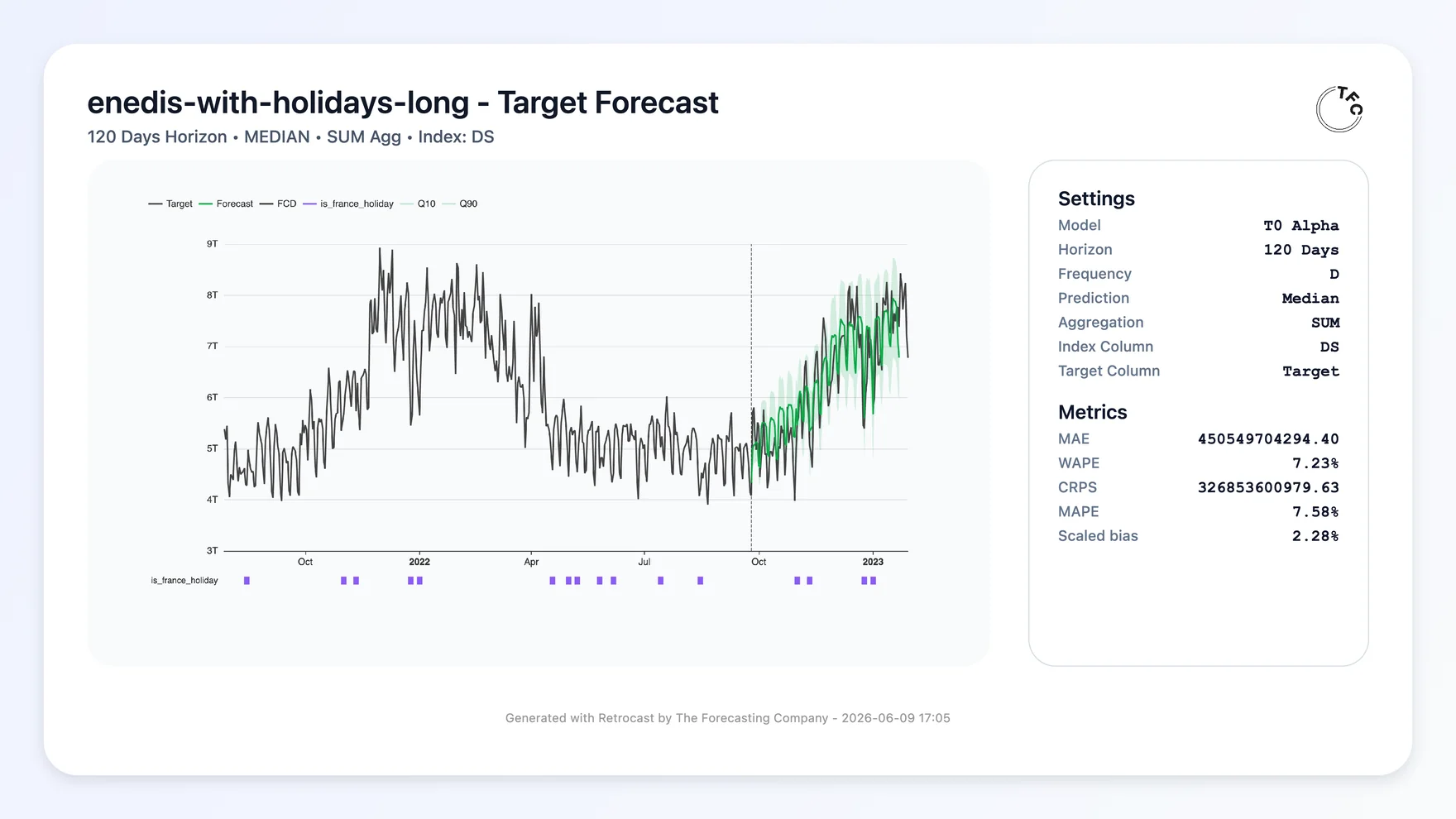
_`t0` forecasting French national electricity demand in Retrocast. Data: [Enedis open data](https://data.enedis.fr/)._
## Model Details
- Model name: `t0-alpha`
- Model family: `t0`
- Developer: [The Forecasting Company](https://theforecastingcompany.com/)
- Task: probabilistic time-series forecasting
- Architecture: decoder-style patch transformer
- Parameters: approximately 102M
- License: Apache-2.0
- Weights: https://huggingface.co/theforecastingcompany/t0-alpha
- PyTorch runtime: [`tfc-t0`](https://pypi.org/project/tfc-t0/)
- MLX runtime: [`tfc-t0-mlx`](https://pypi.org/project/tfc-t0-mlx/)
- Managed API: https://docs.retrocast.com/documentation/t0-alpha
`t0-alpha` is an alpha release intended for research, experimentation, and applied forecasting evaluation.
## Intended Use
`t0-alpha` is intended for probabilistic time-series forecasting. It can be used for univariate and multivariate forecasting, forecasting with historical or known-future covariates and multi-horizon forecasting.
Known-future covariates can include calendar features, planned events, holidays, promotions, weather forecasts, or other external signals available over the forecast horizon.
Forecasts should be treated as probabilistic estimates, not guarantees.
## 📈 Forecasting With Covariates
`t0` leverages covariate information, in the past and future when available, to improve its forecast.
| Without covariates | With covariates |
| ----------------------------------------------------------------- | ----------------------------------------------------------- |
| 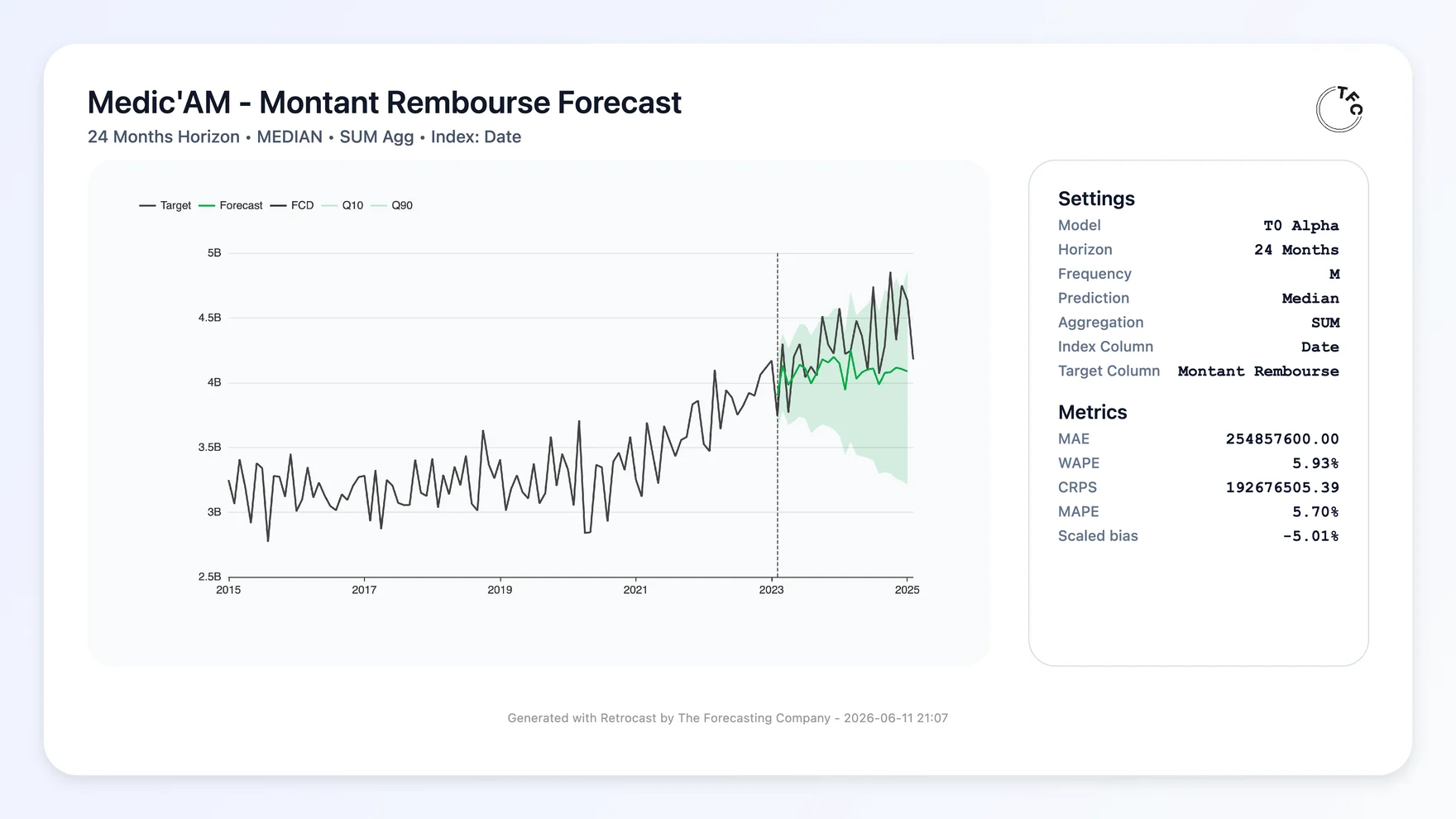 | 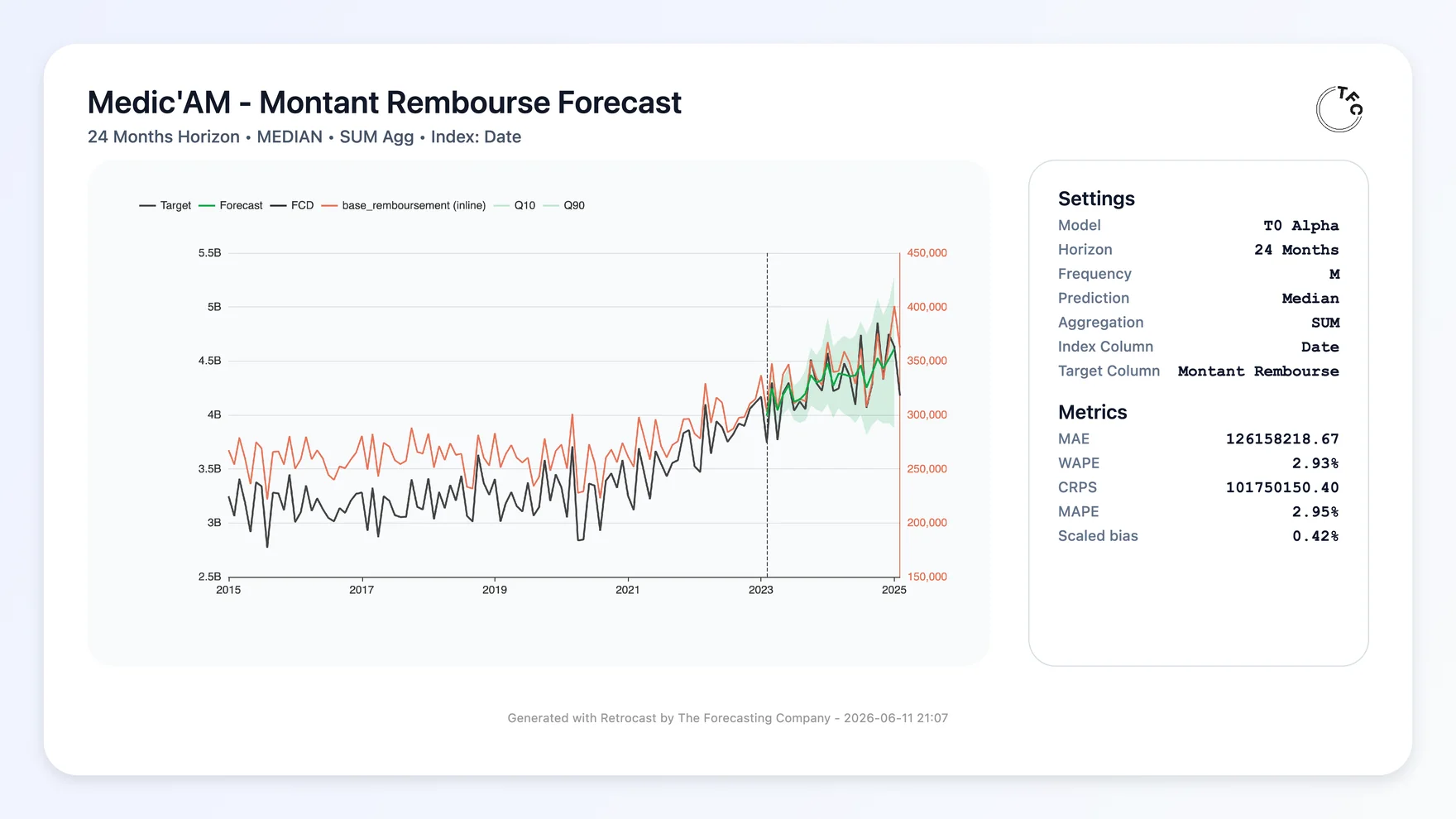 |
_Data: [Medic'AM](https://www.assurance-maladie.ameli.fr/etudes-et-donnees/medicaments-classe-atc-medicam), monthly drug reimbursements from the French national health insurance._
The [Quickstart](#quickstart) below shows the API for both a plain univariate forecast and a multivariate forecast that conditions on historical and known-future covariates.
## Installation
Choose a runtime for the same original `t0-alpha` checkpoint:
| Runtime | Best for | Install |
| --- | --- | --- |
| PyTorch | Broad hardware support and the PyTorch ecosystem | `pip install tfc-t0` |
| MLX | Local, inference-only use on Apple silicon | `pip install tfc-t0-mlx` |
| ONNX FP16 | Accelerator-oriented local and edge deployments | [`t0-alpha-onnx-fp16`](https://huggingface.co/theforecastingcompany/t0-alpha-onnx-fp16) |
| ONNX INT8 | CPU and in-browser inference | [`t0-alpha-onnx-int8`](https://huggingface.co/theforecastingcompany/t0-alpha-onnx-int8) |
| Managed API | Hosted inference without local weights | [`theforecastingcompany` SDK](https://pypi.org/project/theforecastingcompany/) |
### PyTorch
```bash
pip install tfc-t0
```
Requirements:
- Python `>=3.10`
- PyTorch `>=2.4`
Optional extras:
```bash
pip install "tfc-t0[evaluation]"
pip install "tfc-t0[plot]"
```
### MLX on Apple silicon
```bash
pip install tfc-t0-mlx
```
The MLX package uses the same model repository, loads its safetensors directly
and does not install PyTorch.
## 🚀 Quickstart
These weights are public — no authentication is needed to download them.
The simplest path is a univariate forecast through `predict`:
```python
import torch
from t0 import T0Forecaster
model = T0Forecaster.from_pretrained("theforecastingcompany/t0-alpha").eval()
context = torch.randn(4, 512) # 4 series, 512 past timesteps
out = model.predict(context, horizon=64, quantile_levels=[0.1, 0.5, 0.9])
out.quantiles # (4, 64, 3)
out.median # (4, 64)
```
`predict` accepts PyTorch tensors and NumPy arrays.
### MLX Quickstart
The MLX runtime deliberately follows the same forecasting interface:
```python
import numpy as np
from t0_mlx import T0Forecaster
model = T0Forecaster.from_pretrained("theforecastingcompany/t0-alpha").eval()
context = np.random.randn(4, 512).astype(np.float32)
out = model.predict(context, horizon=64, quantile_levels=[0.1, 0.5, 0.9])
out.quantiles.shape # (4, 64, 3)
out.median.shape # (4, 64)
```
See [T0 for MLX](https://github.com/theforecastingcompany/tfc-t0/tree/main/mlx) for
feature coverage, compilation guidance and reproducible Apple-silicon
benchmarks.
### Forecasting With Covariates
Anything known over the past goes in `context`. Alongside the target, extra variates attend to it and are forecast together. Anything known over the future, such as calendar features, planned promotions, or weather forecasts, goes in `future_covariates`, shaped `[B, F, context + horizon]`. The model conditions on it but does not forecast it.
```python
import torch
from t0 import T0Forecaster
model = T0Forecaster.from_pretrained("theforecastingcompany/t0-alpha").eval()
context = torch.randn(2, 512) # 2 series, 512 past timesteps
future_covariates = torch.randn(2, 3, 512 + 64) # 3 covariates known over context + horizon
out = model.predict(
context,
horizon=64,
quantile_levels=[0.1, 0.5, 0.9],
future_covariates=future_covariates,
)
out.quantiles # (2, 64, 3)
out.median # (2, 64)
```
### Batched Inference
```python
import numpy as np
from t0 import T0Forecaster, batch_series
model = T0Forecaster.from_pretrained("theforecastingcompany/t0-alpha").eval()
daily = np.random.randn(180) # one series, 180 past timesteps
store = np.random.randn(2, 96) # one series of 2 variates, 96 past timesteps
hourly = np.random.randn(1024) # one series, 1024 past timesteps
context, mask, group_ids = batch_series([daily, store, hourly])
context.shape # (4, 1024) — variates stacked, right-aligned to the longest series
group_ids # [0, 1, 1, 2] — `store`'s two variates are forecast jointly
out = model.predict(context, horizon=24, quantile_levels=[0.1, 0.5, 0.9], mask=mask, group_ids=group_ids)
out.quantiles # (4, 24, 3)
out.median[0] # the 24-step median forecast for `daily`
```
Integrations that prepare complete T0 inputs, including known-future
covariates, can batch the native representation directly:
```python
from t0 import TimeSeries
first = TimeSeries.from_array(context_1, future_covariates_1)
second = TimeSeries.from_array(context_2, future_covariates_2)
batch = TimeSeries.batch([first, second])
out = model.predict(
batch,
horizon=64,
context_length=max(context_1.shape[-1], context_2.shape[-1]),
)
```
Here each context includes its batch axis, for example `[1, V, T]`, and each
known-future input is `[1, F, T + horizon]`. The output is ordered by the
flattened target rows in `batch`.
### Converting your data to `TimeSeries`
`TimeSeries` is the model's native input. It holds target rows, known-future
covariate rows, a mask and group ids, all on one width. `predict` builds one for
you from a raw array. You only need to construct one yourself to batch inputs of
different widths, or to call `forward` directly.
```python
from t0 import TimeSeries
# context only, with `horizon` marking the region to predict
model_input = TimeSeries.from_array(context, horizon=24) # context: [B, V, T]
# with known-future covariates, whose width sets the horizon
model_input = TimeSeries.from_array(context, future_covariates) # covariates: [B, F, T + 24]
out = model.predict(model_input, horizon=24, quantile_levels=[0.1, 0.5, 0.9])
```
`predict` infers `context_length` from where the forecast region starts. Pass it
explicitly when batching series of different widths. `forward` takes the same
`TimeSeries` and runs a single differentiable pass over it, with no rollout. That
is the entry point for fine-tuning.
**For efficient inference at scale, look at [Retrocast](https://app.retrocast.com/).**
## Input Contract
- `context` may be shaped `(B, T)` for batched univariate forecasting.
- `context` may also be shaped `(T,)`, which is promoted to a single-row batch.
- `context` may be shaped `(B, V, T)` for multiple target variates.
- `future_covariates`, when provided, should be shaped `(B, F, context + horizon)`.
- `mask`, when provided, holds `MaskType` values shaped like `context`: `MISSING` for an absent observation, `PAD` for a cell that only widens a shorter series out to the batch's width.
- NaN in `context` is read as an absent observation. Padding is the case NaN cannot express, so a batch of unequal-length series needs a `mask` (or `batch_series`) to declare it.
- Patches made entirely of `PAD` stay out of attention.
- `group_ids`, when provided, holds one id per row of the context. Rows sharing an id are variates of one series and are forecast jointly.
- `group_ids` cannot be combined with `future_covariates`, which are addressed per sample.
- NaN in `future_covariates` is treated as missing.
- `horizon` must be at least 1.
- Requested quantiles must be non-empty, sorted ascending, unique, and in `(0, 1)`.
- The model was trained to emit quantiles `0.1`, `0.25`, `0.5`, `0.75`, and `0.9`.
- Requested levels between the trained ones are interpolated; levels beyond
them follow exponential tails pinned through the outermost trained levels.
- Horizons up to 1024 timesteps are decoded in one forward pass.
- Longer horizons use autoregressive rollout.
- Returned forecasts are finite `float32` tensors on the model's device.
## 🏗️ Architecture
`t0` is a decoder-style patch transformer.
It encodes each patch from values, within-patch time index, and validity mask. The transformer alternates causal time-axis self-attention with variate-axis group self-attention. Time attention uses time-aware rotary embeddings. Variate attention lets variates in the same sample attend to one another. The stack uses pre-norm RMSNorm blocks, SwiGLU feed-forward layers, and a quantile head.
At inference, target and historical variates are normalized with causal running statistics. Future covariates use per-row global statistics.
| Field | Value |
| --- | --- |
| Parameters | approximately 102M |
| Layers | 24 |
| Layer pattern | 2 time-attention layers, then 1 group-attention layer |
| Time attention layers | 16 |
| Group attention layers | 8 |
| Embedding dim | 512 |
| Feedforward dim | 2048 |
| Attention heads | 8 |
| Patch size | 32 |
| Dropout | 0.1 |
| Scaler | causal mean/std with `arcsinh` transform |
| Native quantile levels | 0.1, 0.25, 0.5, 0.75, 0.9 |
## Evaluation
`t0-alpha` is reported on the [GIFT-Eval leaderboard](https://huggingface.co/spaces/Salesforce/GIFT-Eval) and the [fev-bench leaderboard](https://huggingface.co/spaces/autogluon/fev-bench).
| Benchmark | Metric | Value |
| --- | --- | ---: |
| GIFT-Eval | CRPS | 0.4941 |
| GIFT-Eval | MASE | 0.7240 |
| fev-bench | Skill score | 42.2 |
Users should also evaluate `t0-alpha` on their own historical backtests. Useful checks include quantile loss, CRPS, MASE, empirical quantile coverage, calibration, and breakdowns by frequency, horizon, domain, history length, and covariate availability.
## 🧰 Public API
- `T0Forecaster`: the model itself.
- `Forecast`: the object returned by the model.
- `T0Config`: the configuration of the model.
- `MaskType`: the reason a time step is masked out.
- `VariateType`: whether a row is a target, a historical covariate or a
known-future covariate.
- `batch_series`: utility to batch time series of potentially different lengths.
- `TimeSeries.from_array` / `TimeSeries.batch`: build the model's native input,
including known-future covariates and an explicit forecast `horizon`.
`predict` accepts either a `TimeSeries` or a raw context array.
## 🧬 Lineage and Attributions
`t0` builds on ideas from open-source forecasting models. We gratefully acknowledge:
- **Toto** by Datadog ([repo](https://github.com/DataDog/toto)) and **Chronos-2** by Amazon ([repo](https://github.com/amazon-science/chronos-forecasting)) for factorizing attention in the time and variates dimension.
- **TiRex** by NXAI ([repo](https://github.com/NX-AI/tirex)) for contiguous patch masking.
Code-level attributions are listed in [`NOTICE`](https://huggingface.co/theforecastingcompany/t0-alpha/blob/main/NOTICE), all under Apache-2.0.
## Environmental Impact
Training compute and carbon emissions are not currently reported.
## 📚 Citation
`t0` is described in [t0: A Time-Series Foundation Model for Forecasting with Context](https://arxiv.org/abs/2609.24559). If our model is useful, please cite:
```bibtex
@article{meyer2026t0,
title = {$t_0$: A Time-Series Foundation Model for Forecasting with Context},
author = {Meyer, Lucas and Sole, Claudio and Xiang, Huikan and Li, Nicolas and Franceschino, Lucas and Quera-Bofarull, Arnau and Scholl, Maarten P. and Fainberg, Joachim and N{\'e}giar, Geoffrey},
journal = {arXiv preprint arXiv:2609.24559},
year = {2026},
url = {https://arxiv.org/abs/2609.24559},
}
```
## ⚖️ License
Apache-2.0. See [`LICENSE`](https://huggingface.co/theforecastingcompany/t0-alpha/blob/main/LICENSE) and [`NOTICE`](https://huggingface.co/theforecastingcompany/t0-alpha/blob/main/NOTICE).
## Contact
For issues and bug reports, use the tracker for the relevant runtime:
- PyTorch: https://github.com/theforecastingcompany/tfc-t0/issues
- MLX: https://github.com/theforecastingcompany/tfc-t0/issues